
Other News & Events for December
 |
| Crafts and fun at the 2010 Holiday Open House. |
Off the Rez which will begin at 7:00.
- MIBA Events Next Up: Annual Maine Indian Basketmakers Sale and Demonstration at the Hudson Museum, Collins Center for the Arts December 10, 2011 9:00 - 4:00
- Leon Sockbeson II, whose work is currently featured in Twisted Path II, recently placed #11 in a national contest in which over 600 gown designs were submitted to Adrianna Pappell. This placement qualifies Leon’s design for the second round of the competition; a judging panel will select and produce 5 dresses for another round of voting. Visit http://eandadriannapapellpromotion.com/contest/ for more information on the contest, or to be involved in the next round of voting.
- Read the recent review of Twisted Path II by Rob Levin of the Mount Desert Islander
- A Boston Globe Travel article featuring the Acadia Region had some lovely comments about the Abbe Museum. Read it here.
- "Many Hands: Wabanaki Paths of Learning," is an art exhibition currently on display at University of Southern Maine (Woodbury Campus Center), Portland through Dec. 16. Click here to read about the opening.
- "Tribes in Maine, U.S., look beyond casinos for business" in the Portland Press Herald
- "Passamaquoddy Tribe to create water bottling facility" in the Bangor Daily News
- "Passamaquoddy Teacher Shares Inspiration with Students" in the Morning Sentinel
- "Weaving history and heritage into an art form" in the Boston Globe (please note the Basketmakers Market is on Dec. 10, not Dec. 1)
- "Andrew Sockalexis won Bangor's Thanksgiving Race a century ago" in the Bangor Daily News
- "Mi'kmaq preschoolers get a head start" CBCNews Video
Last Film in the 2011 Series
Join us to watch Off the Rez, which will be followed by a discussion moderated by Raney Bench, Curator of Education.
Off the Rez is the story of Shoni Schimmel. Shoni was a high-school junior living on the Umatilla Indian Reservation in Oregon, the star basketball player on the local team. Then Shoni's mother, Ceci Moses, took a job coaching a high school team in Portland, and against the wishes of her own mother and grandmother on the "Rez," Ceci brought Shoni and her seven other children with her. Now, Shoni's senior year has become the most important year of their lives as mother and daughter fight to prove that Native American women can become champions off the Rez.
For more information about this film, please click here.
The Abbe Museum's third annual film series brings important contemporary films by and about Native people to Bar Harbor. Filmmakers and scholars lead panel discussions following each film. Films are screened in the Community Gallery at the Downtown Abbe Museum, 26 Mount Desert Street, and are free and open to the public. For more information about the film series, visit www.abbemuseum.org.

Holiday Sales & Events
As you prepare for this holiday season, don't forget there are a number of events at the Abbe Museum perfect for family and friends to enjoy! For more details visit our calendar, but here's a quick reminder on some upcoming holiday activities (some newly added since the November issue of eNews!):
Looking for the perfect gift?
Throughout December visit the Abbe Shop for 20% OFF!

Need something last minute?
The Abbe Shop is participating in Wrapped & Ready to Go! Quickly step inside and leave moments later with a pre-wrapped gift for everyone on your list!

Want something for the person who has it all?
Abbe Museum Memberships are the perfect gift that keeps on giving...all year long! Every level of membership is available; just ask for it to be wrapped for the perfect holiday presentation! Wrapped memberships can be purchased at the Abbe Shop, or we can mail them to your special someone...just give us a call or email astra@abbemuseum.org for more details.
You can also make a donation in honor of friends or family this holiday, and we'll send them a special card to share our thanks!
 |
| Sample Gift Membership Insert |
An adorable little ridged hammerstone from the Stephen Wheatland Collection
 |
| Adorable little ridged hammerstone from the Stephen Wheatland Collection |
Help us reach our goals!
Dear Friends,
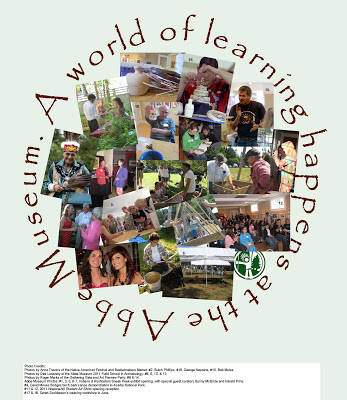
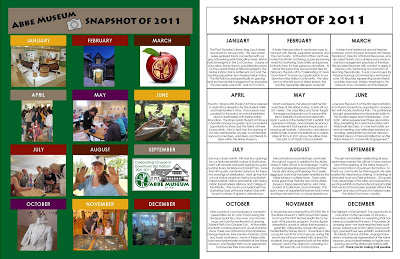
- We opened a major exhibit in July, Indians & Rusticators, which attracted new visitors and helped us to reconnect with friends.
- Visits to the Abbe are up nearly 15% from last year.
- We taught over 3,000 school children at the Abbe and inside classrooms; and, we trained 100 Maine teachers on how to meet the unfunded state mandate (L.D. 291) that requires K-12 students to learn Wabanaki history in the classroom.
 |
| click to enlarge |
Thanksgiving Revisted
“Considering that virtually none of the standard fare surrounding Thanksgiving contains an ounce of authenticity, historical accuracy, or cross-cultural perception, why is it so apparently ingrained?”
--Michael Dorris Why I’m Not Thankful for Thanksgiving 1978
How many of us learned in school that Pilgrims settled in New England, had a rough time making a go of it, and were assisted in their cause by a friendly Native named Squanto? Or, alternatively, they found a pristine wilderness and in trying to learn how to survive, they found help by friendly Squanto. Either way, in gratitude for Squanto’s help, at the first harvest, the Pilgrims invited the Indians for a feast of thanks and friendship, the likes of which the Indians had never seen. If your school was like mine, you learned this while making “authentic” Pilgrim hats with silver buckles, or construction paper feather headdresses and reenacting the event in a play.
The real story, however, is a little bit different. Prior to the arrival of the Pilgrims, Squanto had been kidnapped and taken to Europe, where he learned English. He escaped and returned to New England to find that his entire village had been wiped out by disease. Squanto began working with the Pilgrim colony for his own survival, as much as for theirs.
As James Loewen points out in his book Lies My Teacher Told Me “our archetypal image of this first Thanksgiving portrays the groaning boards in the woods, with the Pilgrims in their starched Sunday best next to their almost naked Indian guests.” (pg. 94) The common suggestion that Indians had never seen such a feast, despite that it consisted of primarily Native foods, continues to marginalize Indians and the role they play in the history of the Americas.
The real story is that Thanksgiving was not introduced by the Pilgrims. For centuries now, each fall Native communities throughout the Americas have been hosting feasts of thanks with the harvest. Our modern celebration began in 1863, when Abraham Lincoln proclaimed it a national holiday, and it wasn’t until the 1890s that the Pilgrims were included in the myth.
It is a welcome break from our hectic lives to sit together as a family, group of friends, or community, and reflect on our blessings and enjoy a shared meal. This is the true story of Thanksgiving- gratitude for the bounty in our lives and honoring of the diverse traditions that create the fabric of our country.
Winter is Here!?!

The surprising snow storm that blew in this past weekend reminded us that winter is just around the corner (or perhaps already here!), and so we'd like to thank everyone for a successful summer and fall. The 2011 season was a busy one for the Abbe Museum, and we could not have done it without your support...thank you!
We are now on our Winter Schedule, which will be in effect until
May of 2012:
Museum Galleries & Shop Open:
Abbe Museum Offices Open:
Please be aware that if there is inclement weather, the Abbe Museum will be closed if MDI Schools are closed. If it is a weekend day or you are unsure, it is always best to check: please call 207-288-3519 before making the trip. The Abbe Museum at Sieur de Monts is closed for the winter; the above hours refer to the Downtown Abbe Museum at 26 Mount Desert Street, Bar Harbor.
There is always something happening at the Abbe Museum, and winter is no exception. Please visit our website or call for our ever-growing list of Winter Programs. Confirmed programs are listed at abbemuseum.org, but there are still more we hope to add!
Winter is also a popular time for school group visits to the museum, as well as bookings for Abbe Educational Programs which can be delivered in the classrooms. If you are interested in visiting the Abbe or having the Abbe visit your school or organization (adult programs can be arranged too!) please browse through the offerings on our website, or contact Raney Bench, Curator of Education.
Click to learn more about School Programs or Outreach Programs for Children & Adults.
Upcoming Holiday Events

The Holidays are fast approaching, and there are a number of events at the Abbe Museum to help you celebrate!
The date is set for our Annual Holiday Open House: Sunday, December 11th from 1pm -- 4pm. Join us that afternoon for for free admission, fun and unique crafts to make and take home, and light refreshments.
There are also exciting Bar Harbor festivities that the Abbe Museum is proud to take part in.
On Saturday, November 12th, wake up early and stay in your pajamas to enjoy the 17th Annual Early Bird Pajama Sale & 4th Annual Bed Races. We'll be open from 6am (yikes!) to 4pm, with special sales, coffee, tea, and other treats from 6am-9am to help keep you going...
Then on Friday, December 2nd stay up late for the Village Holidays & Midnight Madness Sale! From 8pm-Midnight the Abbe will be open with more special holiday sales. Enjoy a classy night on the town and shop in your evening wear!
Native American Film Series
If you missed Apache 8 don't fret...there are still two great films to go! Next up is Feature Film, Smoke Signals, based on the "The Lone Ranger and Tonto Fistfight in Heaven," by Sherman Alexie. This is the first film written, directed, and acted completely by American Indians. Smoke Signals was critically acclaimed as one of the best films of the year and a distinguished winner at the Sundance Film Festival.


Thursday, November 3
7:00 -- 9:00 FREE
Off the Rez
Thursday, December 1
7:00 -- 9:00 FREE
Thanks to Reel Pizza, for making this event possible.
Photo Caption: Shoni Schimmel and her mother and coach, Cecilee Moses. Courtesy of Hock Films
Twisted Path II is Now Open!
Twisted Path II: Contemporary Native American Art Informed by Tradition is now
 open! This beautiful exhibition opened on October 21st, and we were lucky to have all five artists join us for the opening reception! Also joining us that evening were Twisted Path's co-curators, Abenaki artist Rick Hunt and Abbe Museum Curator of Education Raney Bench. Guests that evening enjoyed remarks by both curators, as well as the opportunity to meet the artists: Leon Sockbeson, George Neptune, Sarah Sockbeson, Max Sanipass Romero, and Rhonda Besaw. Stop in soon to see these inspiring artworks. This exhibit is made possible with support from The First and the Fisher Charitable Trust.
 Twisted Path II, open October 2011 through May 2012, is an invitational contemporary art show featuring Native artists from the Northeast. Co-Curators, Rick Hunt & Raney Bench say this about the show:
Native American artists have pushed the boundaries of what is considered traditional art for many years, often facing criticism for working with new materials or creating new designs. There is a perception that Native art is static; that it should never change, or is somehow less authentic with the introduction of new ideas and materials. But, what is traditional? Are glass beads, introduced by Europeans and purchased at trading posts, traditional? What about a basket made to hold eye glasses? Who decides, and how is that decision made?
As co-curator, Rick Hunt, Abenaki, relates,
I am always impressed by how functional pieces can move toward decorative and purposeful design. In this show, it is evident that the pieces reflect a movement away from tradition and become a reflection of the artists’ own personal psychology. There are beautiful ash baskets and Pop Art-type beaded bags, and even contemporary fashion design evolving from traditional northeast Native clothing.
When the first Twisted Path show was conceived, through a technicolor dream of mine, it was envisioned as an exhibit that would highlight the idea of the Native artist evolving and often struggling in this Westernized society. Questions about Native identity, spirituality, art, and traditions emerged. What was illustrated by that first show, and this one, is that Native people and our culture are very much alive and well and here to stay.
Twisted Path II continues the dialogue that introduced the broader society to the concept of the “modern Indian.” Native traditions have grown and evolved, allowing the adaptation and incorporation of new ideas, methods, and concepts into Native culture.
As a result, Native artists are allowed to step out of the confines of entrenched stereotypes in ways that let him or her maintain the integrity of their tribal identity. As such, Native artists are invited and encouraged to explore concepts of modern popular art that can contain distinctive yet subtle flavors of ancient cultures.
Twisted Path II: Contemporary Native American Art Informed by Tradition exhibits the work of five Wabanaki artists from New England. Their work, inspired by traditional materials, methods, and designs breaks from tradition in important ways, becoming a form of expression unique to each artist.
Image Caption: Details of art displayed in Twisted Path II. Listed from top to bottom, 1. Max Sanipass Romero Assimilation Revisited, 2. Rhonda Besaw Fiddleheads, 3. George Neptune Chocolate Wedding Cake, 4. LEON Untitled Sketches, 5. Sarah Sockbeson Untitled Basket. To learn more about the artists, please click here.
Other News & Events for November
 calendar for more details.
If you are in the MDI area this week, make sure to visit us on Thursday, November 3 for the free screening of Smoke Signals which will begin at 7:00.
Soon thereafter the Maine Arts Commission will host a grants workshop. Senior Grants Associate Kathy Ann Shaw will be available to answer questions about funding. She will be joined by Kathleen Mundell, Traditional Arts Specialist, to provide specific information about the agency's traditional arts programs especially those Maine's native communities. The brown bag lunch presentation will take place Monday, November 14 from noon - 2:00 and there is no need to register. More info is available here.
Other events and demonstrations will follow soon thereafter, so make sure to mark your calendar now!
There are also a number of upcoming Wabanaki events that are open to the public. The following links are a sample of some upcoming activities and recent articles that may interest you. Know of more? Feel free to post them on our Facebook page!
-------------
Next Up: Annual Maine Indian Basketmakers
Sale and Demonstration
Hudson Museum, Collins Center for the Arts
-------------
Were Salem's Men Witches' Victims of Politics?
Research by Dr. Mary Beth Norton claims
convicted men were all associated with the Wabanaki
Read the Indian Country Today Article.
-------------
American Anthropological Association, 110th Annual Meeting
-------------
Penobscot River Restoration Project Recognized
Read the Bangor Daily News Article
-------------
Old Town mill seeks to change emissions standards
Read the article in The Maine Campus, citing the reaction of Penobscot Nation Natural Resources Director, John Banks
-------------
From The Bangor Daily News
Help Passamaquoddies by voting for a racino in Calais
Portland Press Herald Letter of the Day by Diane Barnes
------------
Read the article from CBC News
Residential School Survivors Share their Stories
Halifax Media Co-op
Learn more from the Truth & Reconciliation Commission of Canada website about the Atlantic National Event held last week
-------------
Indian Country Today Media Network
-------------
Maliseets to partner with Houlton on additional road work
in the Bangor Daily News
-------------
Tobique First Nation Maliseet Language Project
read about it in CBC News
-------------
The Daily Gleaner
-------------
For those of you in Massachusetts:
Lowell Folklife Series presents lecture on Native American Woodlands Folklife ; November 5th at 2 PM
North American Indian Center in Boston
Boston Globe
-------------
For those of you in New Jersey:
Howell Township Library hosts Micmac exhibition dancer
Asbury Park Press
-------------
Social Media for Social Good Panel Discussion
Camden, Maine, November 5th
Read about it in Village Soup
-------------
University of New England
Donna M. Loring Lecture Series
If you missed these lectures, you can download them
from iTunes for FREE!
Follow the link above for more information.
-------------
David Moses Bridges Canoe Maker Video
-------------
CTV
-------------
Official formation of the Qalipu Mi'kmaq First Nation Band announced by Canadian Federal Government
read about it in The Coaster
-------------
Visit penobscotculture.com to read
classic Penobscot books online!
-------------
Traditional Arts Funding Workshop
If you have ever had questions about funding available through the Maine Arts Commission (www.mainearts.com) then help is just around the corner. Kathy Ann Shaw, Senior Grants Associate will be visiting Bar Harbor in November to provide the answers. She will be joined by Kathleen Mundell, Traditional Arts Specialist, to provide specific information about the agency’s traditional arts programs especially those Maine’s native communities.
This free brown bag workshop will take place from 12 noon and 2 pm on Monday November 14, 2011, and will be hosted by the Abbe Museum in downtown Bar Harbor. The Abbe offers innovative exhibitions and programs on Maine’s Native American heritage. In recent years, the Abbe has grown from a small but lovely trailside museum, privately operated within Acadia National Park, to an exciting contemporary museum in the heart of downtown Bar Harbor. The Museum (www.abbemuseum.org) is located at 26 Mount Desert Street. Bar Harbor, ME 04609. For more information on the exhibitions featured during the workshop please visit: http://www.abbemuseum.org/pages/exhibitions/exhibitions-overview.html.
Kathy and Kathleen will present basic information about the Maine Arts Commission’s grant programs. The presentation will include a review of the National Endowment for the Arts as needed and will feature tips and tricks for grant writing. This will be an informal gathering which will allow participants to ask specific questions and steer the presentation in the direction most helpful to them. There is no need to register. For further information please contact Kathy at 207/287-2750 or kathy.shaw@maine.gov. The Abbe Museum can be reached at 207/ 288-3519.Tea, Popovers, & Archaeology
| Tea, Popovers, & Archaeology is sponsored by The Acadia Corporation. |
This year, Dr. John G. Crock, a Bar Harbor native and Associate Professor of Anthropology at the University of Vermont, will present his research on the archaeology of the small islands of the northern Lesser Antilles where population growth 1,000 years ago was supported by a heavy reliance on seafood, interisland trade, and a religious ideology unique to the Caribbean.
The small islands of the northern Lesser Antilles were some of the first to be settled by sedentary fisher-farmers during the Early Ceramic Age, as early as 500 B.C. Extensive networks of trade and exchange connected island communities with other islands and with their ancestral mainland "home." Over the next millennium, as populations grew and adapted to specific local island environments, systems of exchange developed to support a rapid growth in the number of newly established communities. Higher volumes of differentially available raw materials and finished products were transshipped between islands. By the late Ceramic Age, ca. A.D. 600-1500, Amerindians in these small islands were as maritime-adapted as any in the world, as reflected by their food remains and the off-island origin of materials used to manufacture stone tools, ceramics, adornments and religious paraphernalia. The same interisland systems that supported the subsistence and material needs of coastal communities also supported the maintenance of social networks and cultural connections, both within the northern Lesser Antilles and between the small islands and the Greater Antilles to the west. Archaeologically, this cultural relationship is reflected in the shared importance of ceremonial cave sites, and artifacts that express a broadly shared religious ideology and view of the island world, including three-pointed stone idols, shell ornaments, and decorated ceramics.
Field School in Archaeology: Another Successful Season of Excavation
In mid-August, another successful summer of excavation drew to a close. Artifacts and food animal bones were abundant and now artifacts are back in the lab to be processed so that researchers can piece together the larger picture of life on coastal Maine thousands of years ago.
To learn more about the Abbe Museum Field School in Archaeology, follow these links:
by Abbe Museum Intern, Hannah Wellman
Other News & Events for September
There is always something happening at the Abbe, and this fall and winter are no exception! Please visit our online calendar for more details.
If you are in the MDI area this week, make sure to visit Jordan Pond (or the Downtown Abbe in the case of rain) between 11:00-4:00 on Wednesday (September 14) where Passamaquoddy birch bark artist David Moses Bridges will be presenting with his birch bark canoe! Or stop by the Downtown Abbe Museum on Friday, September 15th between 10:00-11:00 to visit with artist Erik Sappier, Penobscot, as he demonstrates the art of chip carving. And popular annual events such as Tea, Popovers, & Archaeology or the Native American Film Series are quickly approaching, so make sure to mark your calendar now!
There are also a number of upcoming Wabanaki events that are open to the public. The following links are a sample of some upcoming activities and recent articles that may interest you. Know of more? Feel free to post them on our Facebook page!
Next Up: Common Ground Country Fair
Native American Arts Area
10-6, Monday-Saturday during the growing season.
Houlton Band of Maliseet Indians
31st Annual Recognition Day Celebration
Saturday, September 17
Events scheduled 8:00-400 at the Recognition Day Field (Bell Road)
Community Feast & Bonfire 5pm at Maliseet Gym (Foxcroft Road)
All Welcome!
Exhibit Opening September 24 at the Hudson Museum
Transcending Traditions:
The Next Generation and Maine Indian Basketry
Coming to the Abbe in May 2012
Collaborative Seeks Help to Keep
in Maine Ahead
Read Stories in the Rock about petroglyphs in Maine in the
October Issue of Downeast Magazine...on stands now!
Exhibit Evokes Gilded Age Dichotomy
in the Mount Desert Islander
in the Mount Desert Islander
Abbe Celebrates 10 Year Anniversary with Free Admission
in the Bar Harbor Times
Passamaquoddy artist honored nationally,
in the Bangor Daily News
Upcoming Exhibit: Twisted Path II
Twisted Path II: Contemporary Native American Art Informed by Tradition is an invitational contemporary art show featuring Native artists from the Northeast, including:
Rhonda Besaw, Abenaki
George Neptune, Passamaquoddy
Max Romero, Mi'kmaq & Laguna/Taos Pueblo
Leon Sockbeson, Passamaquoddy
Sarah Sockbeson, Penobscot
The exhibition is co-curated by Rick Hunt, Abenaki, and Raney Bench, Curator of Education at the Abbe Museum. Rick and Raney worked together on the first Twisted Path, when they wrote these words describing the show:
Throughout North America, Native people balance the importance of tribal identity and knowledge with the demands of the non-Native communities that surround them. Art serves as one means of survival, expressing a wide range of emotions and experiences, from hopes and fears for the future, to dreams and anger about the past. Breaking away from stereotypes of Native American art and what is "traditional." the work of contemporary Native artists proves that art and culture are not static, but constantly evolving. Borrowed from traditional beadworking, the term "twisted path" is a pattern that meanders along the edge of an object. Here, it is a visual metaphor for the different paths Native American artists walk as they navigate a complex world.
Reflections on a Decade Downtown
 be Museum moving the collections from Sieur de Monts to the state of the art collections facility at the new downtown building. 10 years later, we asked Julia what possibilities became realities with the construction of the "new" Abbe Museum:
A couple of recent things come to mind that would not have been possible without the downtown Abbe:
During the field school, we had a day where the weather was too wet and cool to work on the site. We were able to bring the 20+ participants to the museum for the day to broaden their learning experience. Some worked in the archaeology lab washing and sorting artifacts. Others worked in the learning lab/family circle, identifying animal bones and describing stone arrow and spear points. At mid-day, local archaeologist and Abbe research associate Dr. Rick Will gave a flint-knapping demonstration, and both field school participants and museum guests were treated to an entertaining and informative presentation. There is no way we could have accommodated this group or shared the experience with our guests at the small museum at Sieur de Monts.
Last week I got a phone call from a basket researcher from Santa Fe who is going to be in town this week, and was hoping to take a look at our collection, especially the birch bark pieces. If we were still at Sieur de Monts, with collections stored in plastic totes in the basement, it would have taken much more time to accommodate this visit, and space would have been a major challenge. With the wonderful collections storage facility at the downtown Abbe, I will be able to bring the researcher through the collection, he will be able to see virtually every piece we have at a glance, and if he wants to take a closer look at any particular objects, we have all the space in the archaeology lab available, not just a small table in a dark basement!
Earlier this year, we were able to accept the donation of a collection of objects and associated material made by ethnohistorian and anthropologist Alvin Morrison. The collection, which features primarily Wabanaki and Iroquois objects from the second half of the 20th century, adds wonderfully to our collection, and we would not have been able to accept this collection if we did not have the collections storage space here at the downtown Abbe. A couple of real gems in the collection: a series of small-scale models of a Maliseet basket maker going through the various steps of making a basket, from harvesting the ash tree to weaving the basket; a collection of note cards sold by the Mi'kmaq at the Big Cove Reserve in New Brunswick, featuring prints designed and created by a Mi'kmaq artist, depicting Mi'kmaq stories and legends
An exhibit like Indians & Rusticators would never have been possible at the Sieur de Monts museum, and perhaps most importantly, the downtown Abbe gives local guests the chance to experience the exhibit during the off-season.
Thank You for Making it all Possible...
| Eagle's Nest Basket #1 by Fred Tomah, Maliseet |
What makes the Downtown Abbe Museum special and the experience unique? Here are some thoughts, shared by Abbe Museum staff, about how a second location in downtown Bar Harbor has changed the Abbe experience for the better:
Collections Care has improved dramatically:
One of the big drivers behind plans for a new Abbe Museum facility was the desire to provide improved care for and access to the collections. The downtown Abbe Museum has been largely successful in these two goals. It has also allowed the museum to accept important collections that we would not have had the space for otherwise.
Thousands of school children are served annually:
Due to the size of the building at Sieur de Monts, classes had to take place outside, so there was a limited season in which we could have students. Teachers were told not to come if it was raining. At the "new" Abbe students can visit throughout the year. We have expanded our course offerings to include programs for all grade levels on seven different topics, which all meet state learning requirements. In addition, the new facility has allowed us to host teacher training workshops, bringing teachers together with Wabanaki leaders for direct learning experiences.
Public programming has expanded with the new facility: Demonstrations with Wabanaki artists and musicians take place throughout the summer months downtown, but the facility also allowed the Abbe to expand our program calendar from summers to a full twelve months. We now host brown bag lunch lectures through the middle of winter, a film series in the fall, children's workshops in the early spring and winter, and exhibit openings throughout the year.
These and many other accomplishments are being celebrated this year. The following is an attempt to distill our achievements into a simple Top Ten Countdown:
10.
The Abbe enhances cultural tourism in Maine as a destination experience for the State; we enrich the visitor experience and we contribute to the local economy.
9.
Since 2001, we’ve served over 250,000 people; over 25% of these were schoolchildren.
8.
Exhibit and program space is accessible to all people and we’ve greatly improved the visitor experience.
7.
We can accommodate tour groups year-round and student visits during the school year and we travel to the four corners of the state, delivering educational content in classrooms.
6.
We have instructed over 500 teachers in our workshops, helping them implement LD291 - the Wabanaki Initiative - in the classroom. LD291 celebrates 10 years as state law this year too.
5.
The downtown Abbe offers more space for changing exhibitions and for multiple shows, resulting in over 30 exhibitions.
4.
The Abbe Museum at Sieur de Monts Spring has been preserved as the historic gem that it is and it continues to engage our seasonal visitors.
3.
Our 50,000 piece collection is now stored in a museum-quality environment and we have intellectual control over the collection.
2.
The Abbe gift shop is an economic engine, sending money back into tribal communities and offering a unique shopping experience.
1.
We are now a year-round presence in downtown Bar Harbor, enriching the quality of life for our communities by offering innovative programs, and educational exhibits for all life-long learners.
Thank you for your continued support and generosity, as we celebrate this important milestone.
Abbe Museum Celebrates 10 Years Downtown!
In September 2001, after a successful capital campaign, the Abbe Museum opened its “new” location in a renovated space that once housed the town’s YMCA. The original Abbe, a historic trail-side museum at Sieur de Monts Spring in Acadia National Park, opened in 1928 and is still open seasonally. The new downtown museum provides proper space for the 50,000 piece collection, multiple galleries for changing exhibitions and year-round educational programs and activities for the community. Over the past decade the Abbe Museum has hosted thousands of school children, tour groups, visitors, families, artists, and educators in the comfortable, contemporary spaces of the new facility.
To thank everyone who helped to bring the Abbe downtown and for the community’s continued support, this September the Downtown Abbe will commemorate its 10th anniversary by offering 10 nights of free admission. Earlier this summer the museum opened a blockbuster exhibition entitled: Indians & Rusticators: Wabanakis and Summer Visitors on Mount Desert Island 1840s-1920s. The show, which is up until the end of 2012, offers visitors an opportunity to “step back in time” and experience Bar Harbor a century ago. By staying open late and offering free admission, local residents will have a unique opportunity to experience this and other exhibits that reflect the history of our region. As the busy Bar Harbor summer turns to fall, everyone is invited to help us celebrate by enjoying a free evening of cultural enjoyment at the Abbe in downtown Bar Harbor.
The Details:
What…
FREE Evening Admission to the Downtown Abbe Museum
When…
5:00-7:00 PM, Monday-Friday September 12-16 and 19-23
Where…
The Downtown Abbe Museum, 26 Mount Desert Street, Bar Harbor
Why…
The Abbe Museum is celebrating 10 Years Downtown with 10 nights of FREE admission!
The current exhibitions on display at the Abbe Museum are: Indians & Rusticators: Wabanakis and Summer Visitors on Mount Desert Island 1840s-1920s which highlights the role that Mount Desert Island played in the cultural and economic survival of Wabanakis, The 2011 Waponahki Student Art Show featuring original artworks created by Passamaquoddy and Penobscot students from early childhood education through high school, Objects of our Affection focusing on the effects of agents of deterioration on museum collections, Layers of Time highlighting archaeological research in Maine conducted by the Abbe Museum since 1928, and much more. The regular open hours of the Abbe Museum are 10-5 seven days a week, and regular admission is $6 for adults, $2 for children aged 6-16; Abbe Museum Members, Native Americans, and children under 6 are free. The original Abbe Museum at Sieur de Monts Spring is open 10-5 daily through October 8th and admission for Sieur de Monts only is $3 for adults and $1 for children. Note: This evening special does not include the Abbe at Sieur de Monts, which will operate on a regular schedule.
The Annual Meeting...Read the Presentation!
Ms. Newsom is a member of the Penobscot Nation and serves as their Tribal Historic Preservation Officer. In this capacity, she ensures tribal compliance with the National Historic Preservation Act, identifies and manages historic properties on tribal lands, consults with Federal and State agencies relative to historic site protection, participates in public education initiatives and serves as the tribal point of contact for all archaeological issues. Her former position include a research archaeology position with Archaeological Research Consultants, of Elssworth, Maine and Assistant Director of the Wabanaki Center at the University of Maine.
Ms. Newsom has served on a variety of boards and committees at both the local and national levels. At present, she serves on the repatriation review committee for the Smithsonian Institution and was recently appointed to the University of Maine Board of Trustees.
She holds a B.A. in Anthropology and an M.S. in Quaternary Studies from the University of Maine. Currently, she is a Ph.D. candidate in Anthropology at the University of Massachusetts at Amherst. Her research interests include the archaeology of the Penobscot River Valley and aboriginal ceramic analysis. As an indigenous archaeologist, Ms. Newsom is dedicated to working with and for indigenous communities.
As a military veteran and former leadership instructor with the Maine Army National Guard, Ms. Newsom taught courses in primary leadership, small and large group instructor training and non-commissioned officer training. Currently, she lives in Eddington with her husband, Les, and their four children. The Abbe Museum was honored to have Bonnie Newsom as the guest speaker for our Annual Meeting!