
Opening February 2014 - Twisted Path III, Questions of Balance

Twisted Path III: Questions of Balance
, the latest exhibit in the
, will open in February 2014 and invites artists to consider their personal and cultural connection to place, and how they communicate this through their artwork. Whether from a sense of comfort and pride in one’s homeland, or criticism about the condition of our planet and concerns about environmental genocide, the works of each artist offer a unique perspective expressed through their art. This exhibit will bring together artists engaging in conversations nationally, sharing their voices and experiences to Abbe visitors.
In keeping with our charge to develop Native voice as primary voice in our exhibits and programs, Rick Hunt (Abenaki) will serve as co-curator with Raney Bench, the Abbe’s Curator of Education. Raney and George Neptune (Passamaquoddy), Museum Educator, have designed a program series to accompany this exhibit that includes a variety of artists, media, and learning experiences which will be scheduled throughout 2014. We have recently
in support of the exhibit and accompanying programs.
Eleven artists will join us for this exhibit. Over the next few months, we will profile those artists here. First, we'd like to welcome
, fashion designer from the Taos Peublo, and Gina Brooks, Maliseet ink and pen artist from Maine.
Patricia Michaels
is a traditional native woman who is a style-maker at the forefront of modern fashion design and aesthetics. She creates boldly hip designs with a quality of timeless elegance. Michaels spent her youth between Santa Fe, where her parents operated their art gallery, and Taos Pueblo. In 1985 she apprenticed with the Santa Fe Opera’s costume designer, and then went on to the Institute of American Indian Arts where she studied graphic design, jewelry and traditional techniques. In 2001, after working in Chicago at the Field Museum and an art gallery, she apprenticed with a tailor in Milan, Italy. Michaels later brought her son and daughter with her to New York where she worked in the city’s garment district. After two years there, Michaels developed her own collection, becoming the first Native American to feature a label at the prestigious New York Fashion Week. Michaels competed in the 2013 season 11 of the popular show Project Runway, finishing as runner up and a fan favorite. Now based back home in Taos, Patricia exhibits her work in museums and at fashion weeks in New York and Santa Fe, and her innovative designs have garnered top honors at Santa Fe Indian Market.
Artist Statement for
Twisted Path III
"I create highly individualized pieces that are elegant, fluid, sophisticated, and organic by fusing my own aesthetic with indigenous and European
perspectives.
The detail of every garment, from hand-painted silk feathers, and meshed leather to textures that echo the natural world, I evoke my own history and culture as part of a larger timeless narrative.
Each design tells a story. Just as a river is pierced by a tree branch, time is momentarily anchored within the garment. Each piece is created, is worn, and continues to create fresh new meanings into the future. Every person brings his or her own sense of self into the narrative and enriches the meaning. In this way, we might defy the consumerist sense of fashion as something we can put on, take off, and casually cast aside."


Gina Brooks
is a Maliseet from St. Mary’s First Nation (in New Brunswick, Canada), and resides at Pleasant Point, Maine. She considers herself an artist informed by Wabanaki traditional knowledge. Her art includes brown ash basketry, porcupine quill and birch bark basketry, carving, and print making. Her original prints include acrylic and ink, and lithographs, monotypes, and copper etch plating. She is currently completing her bachelor’s degree in Native Studies at St. Thomas University, Fredericton, NB.
Her basketry and print art has been commissioned by private art collectors and aboriginal organizations from across Canada. Her work has been exhibited in 2011 in a group exhibit at the Charlotte Street Arts Center in Fredericton, NB, Sudbury Nature Center in St. Andrews, NB (Weaving Traditions), and is featured in the New Brunswick Museum’s Wabanaki contemporary art collection in St. John, NB.
Artist Statement for
Twisted Path III
My life is informed by Wabanaki traditional knowledge. My art is inspired by my people, our homeland and things that have historical significance and spiritual depth, which I attempt to communicate in my art. I see art as an opportunity to learn about myself thought ancient stories, symbols, motifs and language. Wabanaki belief systems are woven and etched within the portals and layers of our sacred mother—
skitk
ǝ
mikw
.
My intention is to share examples of Wabanaki art, with their diverse and powerful designs—many of which have also served a very practical purpose in the everyday lives of generations of living and breathing people. Art to the Wabanaki people is an essential aspect of their humanity and a reflection of a communal, spiritual well-being and love of life that flows through the essence of its being—
skitk
ǝ
mikw
.
Beyond technical rendering of the subject, I have extensively researched the historical background of Wabanaki material culture and the spiritual, symbolic significance of distinctive traditional designs. My hope is to gain knowledge and share understanding that can deepen the appreciation of our homeland and my people, a unique experience that can enrich the lives of all people and their environment. In fact, for me, my subject helps in the creation of itself, informs the creative choices I make, and gives the artistic process depth and meaning. I let no social, political, or religious standards interfere with this process. I create from my own truth.
Wabanaki reality is best understood through the traditional language and storytellers, and stories of a creator who is constantly transforming and shape-shifting. Using Wabanaki oral stories, I am better able to deconstruct and reconstruct ideas about Wabanaki present-day issues, and help serve as a portal for the ancient transformative process.
These pieces call on the people of the earth to write a new story in the language of the old ones, a new pipe to signify the commitment to our ancient beliefs and to embrace the sacred journey of giving thanks for life.
Teach the world “
W
ǝ
liwen skitk
ǝ
mikw ciw psiw-
ǝ
te keke
”
– give thanks to the earth for everything it gives.
Abbe receives grant funding for "Twisted Path III"
 We are excited to announce that the Abbe has received two grants for the upcoming feature exhibit Twisted Path III, Questions of Balance.
 The exhibit will be funded in part by a $5000 grant from the Maine Arts Commission, an independent state agency supported by the National Endowment for the Arts. Additionally, an anonymous grant in support of the exhibit has also been rewarded for $10,000.
Read more about the exhibit and keep an eye out for upcoming artist profiles over the next few months.If you would like to sponsor this exhibit and the attendant educational programs, please contact Hannah Whalen at hannah@abbemuseum.org or 207-288-3519.
The history of the Twisted Path exhibits
Throughout North America, Native people balance the importance of tribal identity and knowledge with the non-Native communities that surround them. Art serves as one means of survival, expressing a wide range of emotions and experiences, from hopes and fears for the future, to dreams and anger about the past. Breaking away from stereotypes of Native American art and what is considered "traditional," the work of contemporary Native artists proves that art and culture are not static, but constantly evolving.
 | |
| Blanket stories, by Marie Watt |
Twisted Path: Contemporary Native American Artists Walking in Two Worlds opened in 2009, and featured nationally and regionally renowned artists whose works expressed the complexities surrounding Native identity.

5th Annual Native American Film Festival

October at the Abbe
 |
| The newly completed education canoe, about to be launched for the first time. |
See you soon!
Johannah
The Government Shutdown and the Abbe Museum
The closure of Acadia National Park has direct implications for some of the Abbe's programming and other offerings. Here are the things to know about how the government shutdown has affected the Abbe:
- The Abbe's location at Sieur de Monts Spring is closed. Luckily, this location was scheduled to close on October 14th, and while we are certainly sad to see it close early, we hope visitors to the downtown location will enjoy the installation of Saint Sauveur, a new exhibit that has been on display at the Sieur de Monts Spring location over this summer. We hope to have the exhibit in place very soon.
- Our popular program, "Tea, Popovers, and Archaeology" will continue, if the Park reopens by October 21. Should the shutdown be prolonged, we will re-tool this program - please stay tuned for updates.
In acknowledging the loss that is the early closing of Acadia National Park at a time of year when the park is so beautiful, we also wish to encourage visitors to continue to enjoy Mount Desert Island and the many activities, outdoors and in, that are still available. We are happy to direct guests to ways to enjoy the island while the park is closed and offer any additional support possible to enhance each visitor's experience this fall.David E. Putnam, Lecturer of Science at the University of Maine at Presque Isle, will shaure his personal evolution as a prehistoric archaeologist in Maine, and how his own attitudes about the interests of Native American/First Nations people in archaeological issues initially reflected those of his peers and community. - See more at: http://www.abbemuseum.org/calendar/october.html#sthash.qglOg9Wl.dpuf
Tea & Popovers, 2013!
 We hope you will be able to join us for this year's Tea, Popovers and Archaeology on Monday, October 21 from 7:00 - 9:00 pm at the Jordan Pond house in Acadia National Park.
David E. Putnam, Lecturer of Science at the University of Maine at Presque Isle, will share his personal evolution as a prehistoric archaeologist in Maine, and how his own attitudes about the interests of Native American/First Nations people in archaeological issues initially reflected those of his peers and community. That “mainestream” paradigm was challenged by moving to Montana and Alaska, living in Native communities, and working for tribal groups. Returning to northern Maine in 1995, he embarked on a new career trajectory and an enhanced relationship with the Mi’kmaq and Maliseet people of the region. The rich partnership that developed has resulted in numerous joint initiatives with the bands of northern Maine, and the First Nations of New Brunswick and Quebec.
Please note: this program will continued as scheduled if Acadia National Park reopens by October 21. Should the partial government shutdown be prolonged, we will re-tool this program - please stay tuned for updates.
Tickets for the event are $20 for Abbe members and $30 for non-members. Reservations are required, by phone at 288-3519 or by emailing educator@abbemuseum.org. This event is sponsored by the Acadia Corporation.
FILM FORWARD at the Abbe Museum
 |
| Copyright Grey Villet |
We hope you can join us on October 1 for The Loving Story. A racially-charged criminal trial and a heart-rending love story converge in this documentary about Mildred and Richard Loving, a part-black, part-Indian woman married to a white man in Jim Crow era Virginia. Thrown into rat-infested jails and exiled from their hometown for 25 years, the Lovings fought back and changed history. The Loving v. Virginia Supreme Court case overturned miscegenation laws that affects mixed-race marriages across the country. Following the film, there will be a panel discussion led by Raney Bench and Robert Shetterly that will look at how these laws were applied in Maine. Directed by Nancy Buirski.
To learn more about FILM FORWARD, visit sundance.org/filmforward or email filmforward@sundance.org. This program is cosponsored by the Truth and Reconciliation Commission. Additional FILM FORWARD events hosted by MDIHS, Reel Pizza, Northeast Harbor Public Library and COA.


Children’s Workshop with David Moses Bridges
 On Saturday, October 26 from 10:00am - 12:00pm, David Moses Bridges, Passamaquoddy, will lead a workshop for children entitled Wikhikonik: Birchbark Maps and Wabanaki Guides.
 When traveling to remote places, Wabanaki guides and other members of the tribes made maps on birchbark to communicate with one another. If separated from your party, you could use a map with a few simple symbols to learn where your party has been, where your party went, and where their final destination would be.These maps were also created to help Europeans travel from one place to another when a guide was unavailable. In this workshop, plan a journey to one of your favorite places, and learn how to translate that journey onto a wikhikon. Plan a trip on a river near your home, or make up a journey to an imaginary place, and use your wikhikon to tell us about your travels! David Moses Bridges, Passamaquoddy from Sipayik (Pleasant Point), is an award winning birchbark artist who has received national recognition for his work. From full-size birchbark canoes to small etched containers, David is a master of his craft and creates both traditional and contemporary pieces.
The Abbe welcomes new intern, Viginia Mellen!
 The Abbe is pleased to welcome recent College of the Atlantic graduate, Virginia Mellen, on as an intern this fall. We originally met Virginia while she was working on a project for Friends of Island History. She completed a comprehensive Historical Resource Index Survey, gathering important information from local museums, libraries and historical societies and compiling all that information into a report that is incredibly thorough.
 Virginia comes to us with quite an impressive resume. She has worked as a faculty assistant at the College of the Atlantic, an interpretive ranger at Acadia National Park, a co-curator at the Naturalist's Notebook, a researcher at the Bar Harbor Whale Museum and Allied Whale and, most recently, as a lead intern at the Smithsonian Center for Folklife and Cultural Heritage.
Virginia will begin her volunteer work with us doing a marketing survey and helping out in various ways with marketing and development. She will also be working on upcoming exhibits and educational programming development.
We are thrilled to have Virginia on board!
Fall at the Abbe
 |
| Steve Cayard and David Moses Bridges work on the canoe. |
With the rainy, cool entry into September, the coming of fall certainly seems to be here. It is always bittersweet to bid the warm, fun-filled months of summer farewell, but we have some exciting celebrations of fall planned at the Abbe and we hope to see you around as the leaves begin to turn.
A Canoe is Built
Over the course of the past month, experienced birchbark canoe-builders, David Moses Bridges, Passamaquoddy, and Steve Cayard have been working five days a week in the courtyard at the Abbe to build a 14’ canoe. Hundreds of visitors have been able to see the canoe in process and talk to the builders. Visitors watched as the frame was built, the birchbark was unfurled, the ribs were constructed and put in place, the bark was attached, and etchings were selected and carefully and artistically completed. The canoe build will culminate this Friday with a reception and viewing from 6:00 – 9:00 pm during the final Art Walk of the summer. Here is a photo diary that captures the canoe’s construction over the past month.
 |
| Assembling the building bed. |
 |
| Inserting the winter bark panels. |
 |
| Measuring and bending the ribs. |
 |
| Unrolling the bark - the canoe is made from one sheet of bark. This piece is 16' long. |
 |
| Weighing the bark so it doesn't curl. It's important to keep it hot and wet so it doesn't crack. |
 |
| Holding the bark in place while it dries. When the wood posts are removed, the bark will keep its shape. |
 |
| Placing the frame on the bark. |
 |
| Placing the frame on the bark and weighing it down. |
 |
| Spruce roots laying across the boat to measure lengths. |
 |
| Setting the ribs and planks at the same time. |
 |
| Close-up of the ribs and planks. |
 |
| Securing the frame to the bark with maple pegs and spruce root. |
 |
| Locking in the ribs. |
 |
| Lashing the bark to the frame with spruce roots. |
 |
| Golf tees hold the layers together while David uses spruce roots to lash the bow of the boat. |
 |
| Piercing holes in the bark layers at the bow of the boat. |
 |
| Soaking spruce roots used for lashing. |
 |
| The bow of the boat lashed with spruce roots. |
Abbe Field School 2013

On Day One, the students worked with Dr. Art Spiess, Abbe Curator of Collections Julia Clark, and field supervisor Jane Clifton to lay out their excavation units on the site grid. A couple of the units had been started in previous years, so some students spent the first hour or so digging out the back-fill so they could pick up where previous excavations ended. Eventually everyone got started on their excavation units. The weather was beautiful, if a bit windy! At lunchtime, field school participant and Department of Environmental Protection fish biologist Dave Halliwell shared some of his extensive knowledge of the freshwater fish of Maine. In the evening, students delved into the analysis of animal bones with Dr. Spiess and Jane Clifton.


the very special event of Museum Educator George Neptune coming out to the site and playing and singing traditional Wabanaki songs with his drum, bringing language and music back to a place that has not heard the music of its original inhabitants for hundreds of years. And it gave the Field School students another way to learn more about the people who once lived at Tranquility Farm. Several students excavating near the outside edge of the site uncovered dark, most soils full of charcoal associated with a fire pit first identified during last years field school. In the evening, the students and supervisors gathered for a social evening of food and conversation.

On Day Five, the weather grew significantly worse, but there were several units that had to be finished, and the critical work of documenting the excavation had to be completed. With a brief escape to the shelter of vehicles to be safe from a passing thunderstorm, the indomitable students were able to complete the record keeping. One unit will have to await next year for completion. The final task of every field school then followed- the careful back-filling of the square excavation units, with the aim of returning the site to it natural appearance. While the wet, muddy conditions made this a bit of a challenge, the gracious property owner confirmed later that once the sun came back out and the field dried, it looked just fine!
It was a wonderful, successful week, with a great group of students, and we are looking forward to returning to Tranquility Farm next summer. The dates for the 2014 Field School are August 3-8. Contact Julia at the Abbe at (207)288-3519 or julia@abbemuseum.org if you would like more information!
The Abbe Goes Back to School
 |
| Raney Bench, Abbe Museum Curator of Education and students at the touch table. |
Teachers come too, for workshops, resources, and support from our staff. But our education work extends far beyond Bar Harbor. Abbe education staff and volunteers travel throughout the state, working with schools and teachers too distant to make a day-trip to Bar Harbor. Our artifacts travel, reaching children from Cumberland to Aroostook.
 |
| Students explore the touch table. |
Acadia Night Sky Festival

Additional, Neptune will be on the Night Sky Cruise on Friday night, sharing additional Wabanaki star stories (but a whole different set of stories from those that he'll be sharing Saturday night - so come both nights if you can!).
See the complete schedule of events for the entire Festival and enjoy!
Tea and Popovers 2013!
An archaeologist’s education in the northlands
 |
| David Putnam at work. |

Wabanaki Guides Lecture: Modern Guiding Practices
 While the role of the Wabanaki guide
has been an important part of the history of the territory now known as Maine
for over 400 years, certain aspects of guiding have changed drastically over
time. As with any profession, each person who works as a guide takes a
slightly different approach to their work. On Thursday, September 12 from 6:00 – 8:00pm
at the Abbe Museum, Penobscot guides and longtime friends Ron Bear and Dean
Francis will compare and contrast their personal guiding styles, and explain
how they keep guiding traditions alive in an ever-changing environment.
While the role of the Wabanaki guide
has been an important part of the history of the territory now known as Maine
for over 400 years, certain aspects of guiding have changed drastically over
time. As with any profession, each person who works as a guide takes a
slightly different approach to their work. On Thursday, September 12 from 6:00 – 8:00pm
at the Abbe Museum, Penobscot guides and longtime friends Ron Bear and Dean
Francis will compare and contrast their personal guiding styles, and explain
how they keep guiding traditions alive in an ever-changing environment.Happy August!
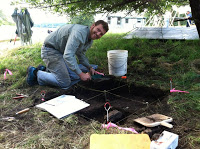
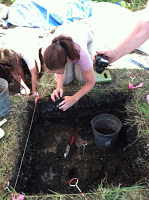 As I write, the sun is beaming down outside. The Abbe's annual archaeological field school is happening this week, and what beautiful weather it has been! News and photos have been pouring in from the field, and it sounds like they've uncovered several exciting artifacts already. Visit our facebook page for updates and photos.
August at the Abbe is a happening time; we are offering several programs each week and, beginning August 12 and running through September 6, the Abbe will host our first ever artist-in-residence program: a birchbark canoe build with David Moses Bridges, Passamaquoddy, and Steve Cayard. Our Park Series, offered in collaboration with Acadia National Park, continues this month and next with demonstrations in beadworking, working with birchbark, ash pounding and several concerts. For our complete schedule of public programming, visit our calendar page.
We look forward to seeing you at the Abbe this August, as we all celebrate those last beautiful days of summer. Looking ahead to fall, we are excited for the second Pecha Kucha MDI event in September and then, before we know it, Tea and Popovers will be rolling around again! Happy August to all.
Johannah
Birchbark Canoe Build at the Abbe Museum!
 From
August 12 through September 6, from 10:00 am to 5:00 pm Monday through Friday,
the Abbe Museum will host an artist-in-residence program featuring the building
of a full-sized birchbark canoe the first time one has been built on MDI in
almost 100 years. David Moses Bridges,
Passamaquoddy, and Steve Cayard, both skilled builders of birchbark canoes in
the Wabanaki tradition, harvested the materials and will be building a 14’
canoe as a public demonstration. The
canoe will become part of the teaching collection at the Abbe Museum, able to
travel to schools and public programs outside of the building, and to be
paddled during demonstrations.
From
August 12 through September 6, from 10:00 am to 5:00 pm Monday through Friday,
the Abbe Museum will host an artist-in-residence program featuring the building
of a full-sized birchbark canoe the first time one has been built on MDI in
almost 100 years. David Moses Bridges,
Passamaquoddy, and Steve Cayard, both skilled builders of birchbark canoes in
the Wabanaki tradition, harvested the materials and will be building a 14’
canoe as a public demonstration. The
canoe will become part of the teaching collection at the Abbe Museum, able to
travel to schools and public programs outside of the building, and to be
paddled during demonstrations.
2013 Gathering Gala a Tremendous Success
All of the Gala contributions make it possible for the Abbe to continue producing educational programs and exhibits that inspire thousands of visitors and students and encourage people of all ages and background to learn about the history and contemporary lives of the Wabanaki Nations. This year, the gifts from the paddle raise will be used to match the 3-year grant that the Abbe received from the Institute for Museum and Library Services which will allow the Abbe to produce teaching resources and support for over 800 teachers and travel to all 16 counties of Maine working with the Tribes and the Maine Department of Education to offer on-site workshops, training and community networking.
From the Board of Trustees and the Abbe staff, a huge thank you to all who played a role in the Gala, contributing to the financial health and vibrancy of the Abbe Museum. Your generosity ensures that we will continue to shine as a beacon of learning for our local communities, the state of Maine, and around the world.
Check out the photos from the evening, thanks to Eager Eye Photography!