Abbe Museum Abbe Museum

The Big Read


The Big Read is currently underway!  Readers on Mount Desert Island, Frenchboro, Swans Island, Little Cranberry Island, Deer Isle, Stonington, and Isle au Haut have picked up their copies of The Adventures of Tom Sawyer by Mark Twain and have participated in community-wide programs throughout the past month, thanks to a grant from the National Endowment of the Arts awarded to partner organizations Island Readers & Writers and the Northeast Harbor Library.  The Abbe Museum has jumped on board for the fun, and Raney Bench, Curator of Education, has organized numerous public programs and events facilitating discussions of stereotyping surrounding the characterization of Native Americans in Twain's books.  In The Adventures of Tom Sawyer these stereotypes are revealed through the portrayal of Injun Joe and his interactions with Tom and Huck.


As part of The Big Read, Raney has discussed these topics with both adults and children.  She ran a program in Deer Isle for approximately 90 schoolchildren representing the third, fourth, and fifth grades.  The stereotyping program for children this age begins with an activity designed to help create a safe learning environment in which stereotypes, a sometimes difficult topic, can be comfortably explored.  The children are asked to share words that they have heard in association with Indians, and assured that by sharing these words it does not imply that they believe those ideas.  The kids are generally shy at first and quickly warm up, filling a whiteboard with these terms.  After a large list has been generated, the children walk though those stereotypes identifying which are positive, negative, and neutral as Raney simultaneously breaks the ideas down to dispel myths.  At the end of the exercise, the children come to the conclusion that all stereotypes -- positive, negative and neutral -- are harmful because they prevent the ability to understand someone as an individual.  After the  exercise, students looked at the characterization of Indians in The Adventures of Tom Sawyer, specifically Injun Joe, and discussed how Twain's bias towards Indians is reflected in his writings.  These ideas were used as a base from which students then explored how life in Maine was different from Twain's stereotypes, looking closely at the interactions between Native and non-Native people.

A similar program will be presented later this month to a slightly older audience.  Raney Bench will again travel to Deer Isle to present to the sixth, seventh, and eighth graders, and will this time be accompanied by historian and Abbe Museum Trustee, Bill Haviland.  Raney will begin this program by presenting the notions people held about Indians at the time of Tom Sawyer's publication at the national level, including ideas that Indians were noble, savage, and a dying race.  The Adventures of Tom Sawyer will be used as a platform to discuss how Mark Twain, as a contemporary of that time, represented his bias through his writings.  Bill Haviland will then contrast those ideas with the relationship between the Wabanaki and other Mainers at that time, to illustrate the differences between the east and west.  The perception of a frontier, the wild west, and the time period of Indian removal is also the era of the Abbe's blockbuster exhibit Indians & Rusticators, and together Raney & Bill will illustrate some of this local and national history.

College-aged students have also benefited from The Big Read programs, as Jan Coates, Director of Island Readers & Writers, and Raney Bench teamed up to present to students at College of the Atlantic.  This presentation, made to a group of future-teachers, focused on how informal education partners can enhance learning for students.  Raney and Jan used the model of The Big Read to illustrate opportunities for schools to link with various non-profit organizations in an effort to offer creative program initiatives.

If you are an adult wishing you had the opportunity to participate in these exciting programs then have no fear...If you haven't joined The Big Read yet, there is still time!  A full calendar of programs can be found at the Island Readers & Writers website, and the Abbe Museum will be hosting these upcoming events, discussing the era of Mark Twain and the characterization of Native Americans during these programs:

Sunday, February 5, 2:00-3:30
Exhibit Tour of Indians & RusticatorsFriday, February 10, 6:00-7:30
A Closer Look at Injun Joe
Read More
Abbe Museum Abbe Museum

New Acquisitions from the Frank T. Siebert Collection

The Frank T. Siebert Collection, which had been on long-term loan to the Abbe Museum for approximately 10 years, was withdrawn by the owner last year, and put up for auction at Skinner Auctions in September 2011. A group was formed, the Penobscot Material Culture Collaborative, to come up with strategies and funds to save as much of the collection as possible for the public trust and for the Penobscot Nation- to keep the collection in public institutions and not lose it to private collections and dealers. The Abbe provided a variety of support for the collaborative, but did not have funds to offer for the effort at the time.   

Link to more information about the Frank T. Siebert Collection:

The auction was not particularly successful, with many items selling at well below their estimated value, and a number of lots not even reaching their reserve. The Hudson Museum was able to purchase a variety of lots, primarily lower cost lots with more cultural/historical/interpretive value. A pool of funds from the Penobscot Nation, the Maine Indian Basketmakers Alliance and the Bangor Museum & Center for History was used to purchase one of the top priority pieces, a woven basswood bark bag, which is now owned by MIBA and stored and exhibited at the Hudson. The Maine State Museum went to the auction with funds, but was unable to purchase their top priority item.


A month or so after the auction, the Maine State Museum was contacted by the owner offering to sell any of the remaining lots directly, with the sale handled by Skinner. They were able to purchase two important items from the collection- a wampum collar and a set of wool leggings with elaborate bead and ribbon work. The Abbe heard through MIBA and the Hudson Museum that the remaining lots were being offered for sale, and contacted Skinner to inquire. We offered amounts well below the auction estimates, and with several very small adjustments, our offers were accepted.

This means that the large majority, if not all, of the Penobscot material from the collection that remained unsold after the auction has now been acquired by Maine museums and will come home to Maine, joining the important acquisitions made during the auction.

While we all regret that a number of very significant pieces from the collection are now gone into private collections and no longer accessible to the Penobscot Nation or the wider Maine community, many pieces from the collection were saved for the public trust, and will remain here in Maine, where they belong, accessible to the Penobscot people, in perpetuity.  
  
Click here to learn more about the Abbe Museum's acquisitions.

We are pleased to share this summary of the new acquisitions:

Lot 286, Red Stroud Leggings, mid-19th century

Lot 286, Red Stroud Leggins

Portrait of Francis Stanislaus in leggings

These leggings were part of the Stanislaus family regalia, passed down through at least two generations. Probably made in the mid-19th century, we see a young Francis wearing them in a studio portrait taken in the later part of the century. The collar and cuffs were sold at the September auction (to unknown buyers), but the pieces worn here as a belt were acquired by the Maine State Museum. The Stanislaus family was part of a small Penobscot community that lived most of the time in the Lincoln, Maine area. They were among Siebert's key language informants. Francis's father Stephen Stanislaus was governor of the Penobscot Nation off and on during the 1870s and 1880s.

Lot 310, Sylvia Stanislaus medal

Lot 310, Sylvia Stanislaus medal

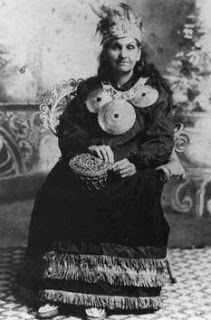
Sylvia Stanislaus


This medal was given to Sylvia Stanislaus by the governor of Maine, Louis Brann, on the occasion of her 100th birthday in 1936. Sylvia is shown in the studio portrait to the right. The wampum collar seen in this photo was acquired by the Maine State Museum.

Lot 322, Seven beaded cloth items

Lot 322, Seven beaded cloth items

Frank Siebert cultivated long-term friendships with his Native language teachers. He commissioned the top five examples of beadwork from Lewis Lolar (or Lola). He and his wife, Elizabeth, lived on Indian Island and made baskets and beadwork. Mr. Lolar also served as Lt. Governor during the 1930s. We do not have any provenance on the green piece at the bottom.  While not among the most aesthetically pleasing beadwork in the Siebert Collection, their direct relationship to an important Penobscot individual, and his important relationship with Siebert, make them culturally and historically important.

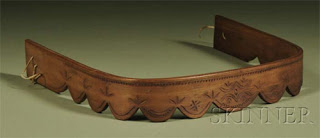
Lot 293, Cradleboard hoop

Lot 293, Cradleboard hoop

From Frank Speck


This cradleboard hoop's carvings hint at the elaborate scroll-work that would be present on the board from which it came. This is a particularly fine and well-executed example of late 19th - early 20th century Penobscot carving. Unfortunately, we do not know what happened to the rest of the cradleboard. This piece documents an important tradition of fine woodcarving among Penobscot artisans that continues today with the work of carvers such as Stan Neptune, Joe Dana, Richard Love and Eric Sappier. The photo shows an example of a finely carved cradleboard documented by Frank Speck in the early 20th century.


Lot 302, Band Box Basket, ca. 1865

Lot 302, Band Box Basket


This ash splint basket is a form created in the mid-19th century by Wabanaki basketmakers to sell to non-Native customers. Penobscot basketmakers were inspired by hat storage boxes to make storage baskets. They could be stored beneath a high bed and were ideal for stagecoach and packet travelers who desired a light, strong traveling trunk (Fannie Hardy Eckstorm 1931). Some Wabanaki families put them to the same use. This piece probably came from the Stanislaus family. At least two other band box baskets from the collection were purchased by the Hudson Museum at the September auction.

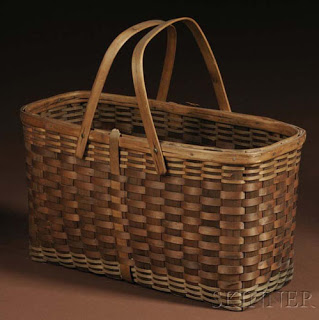
Lot 303, Shopper basket, by Joseph Gabriel, ca.1936

Lot 303. Shopper basket, by Joseph Gabriel, ca. 1936


This basket, commonly referred to as a market or shopper basket, is an extraordinarily well documented early 20th century ash splint basket.  While the Abbe Museum may have some comparable baskets, the fact that the maker of this basket is known makes it quite important. Until the 1980s, basketmakers did not sign their work (some still hesitate to do so), and so in the large majority of earlier baskets, the maker will never be known. With a little additional research, we may well be able to learn more about Joseph Gabriel and put a face with this basket.

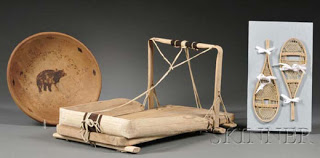
Lot 321, Wooden items

Lot 321, Wooden Items


The three items in this lot represent a mix of Penobscot material culture. The use and history of the wooden bowl is unknown, but it may have been used to play a dice game similar to Waltes, where two-sided, disk-shaped dice of bone or antler are placed in the bowl, the bowl is struck against the floor/ground, and scoring is based on how many dice land on each face of the disks. The cradleboard may be a rough reproduction made for Siebert as part of his research, and does not appear to have been used. The miniature snowshoes are typical "tourist art," a small-scale version of a traditional Penobscot item that was sold to tourists and visitors as a souvenir, or possibly as a toy.

Lot 298, Four birchbark items

Lot 298, Four birchbark items


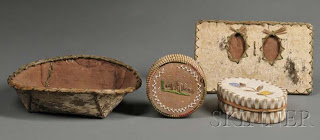
These four objects are a mix of Wabanaki and other eastern Woodlands craft. The birchbark dish and picture frame are typical "tourist art" forms of the first part of the 20th century. Both are forms that are not well-represented in the Abbe's collection, and useful to telling the stories like those encountered in the Indians & Rusticators exhibit. The two quilled boxes are not Wabanaki, but are from related groups. The round box with the beaver on the lid was made by the Ojibwe of Manitoulin Island in Lake Huron. There is actually a strong link between the Ojibwe and the Wabanaki- Ojibwe origin stories tell of them moving into the Great Lakes area from a land to the east next to the ocean, where the Waban were left behind to defend the continent from a future threat foretold in their stories, now believed to refer to the arrival of Europeans. Ojibwe cultural and spiritual leaders have been working with the Passamaquoddy over the last several years to better understand the Machias Bay petroglyphs, as much of the symbolism has been maintained in Ojibwe culture. The oval box is believed to be Odawa, a related group, and both were likely made in the 1930s.

Lot 317, Four wooden clubs

Lot 317, Four wooden clubs


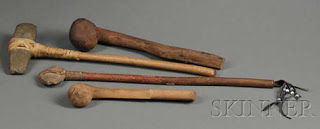
While two of the items in this lot, the ball headed clubs on the top and bottom, are likely not Wabanaki, the other two items have educational value for the Abbe. The upper middle piece is a genuine archaeological stone ax/adz head that has been hafted onto a modern handle. While at the Abbe, this piece has been used in the exhibit at Sieur de Mont to show what a stone tool like this would look like when hafted to a handle, which is often diffifult for our visitors to visualize when only the stone is present. The lower middle piece is another piece of "tourist art," a roughly made stone head lashed to a painted, chip-carved handle with beaded fringe. The chip-carving on the handle is Penobscot in style. Pieces such of this may have been popular souvenirs for visitors to Indian Island or to the Wabanaki encampments on MDI and around the state.

Lot 320, Seven hide items

Lot 320, Seven hide items


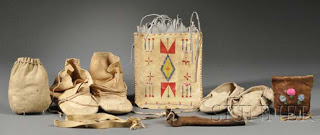
While several of these items are marginal to the Wabanaki, they have educational value for the Abbe. Items made of animal hide (primarily moose and deer) would have been common in traditional Wabanaki material culture, but are poorly represented in our collection.

The plain hide pouch to the left actually held the wampum pieces from the collection when they arrived at the Abbe in 2001, so is quite likely Penobscot. The two pairs of moccasins are Montagnais and were collected at Lake St. John (Pointe Bleue), Quebec while Seibert was doing linguistic research there. They are probably not all that different from traditional Penobscot footwear. The fur pouch on the right is decorated with dyed moosehair tufting, and is Huron. Women of the Huron-Wendat village in Loretteville, Quebec had a long tradition of working with moosehair as an embroidery material. Based on other examples in the Siebert and other collections, Huron moosehair embroidery pieces were sold at Native encampments in coastal Maine, either by Huron families who traveled here, or by Wabanaki who traded for the items. The parfleche in the middle is not traditional to the northeast, and is clearly a later 20th century reproduction, again probably "tourist art."
Read More
Abbe Museum Abbe Museum

The Abbe Museum welcomes Nora Miller, our new Event Coordinator!

I am so pleased to be working with the Abbe Museum! As a born and raised local, I have many fond memories of the Abbe from school visits to summer camp excursions.  I have hit the ground running in these first few weeks learning my way around the facilities, getting to know the fabulous staff and gathering information about past Abbe events and our plans for this year.  We have lots of exciting activities in store and I hope to see all of you at our upcoming functions!

Most recently I have been working with the Abbe team to organize the 2012 Spring Garden Tour which will take place at the W.P. Stewart Estate on June 2 & 9, 2012. The Abbe is the fortunate beneficiary of this year's proceeds and we have our work cut out for us in staffing and organizing this fun and colorful event.  If you would like to jumpstart your spring and start dreaming with us of azaleas and sunshine then please do not hesitate to call the museum and become a Garden Tour Volunteer.

Looking for a unique and interesting setting for your next meeting, work function, reception, party or wedding? Come visit the Abbe Museum as a rental facility. Not only are you guaranteed to have a fabulous time, but your use of the Abbe supports our mission and education program.

To welcome Nora, learn more about holding your event at the Abbe Museum, or to become a Garden Tour Volunteer please call 207.288.3519 or email nora@abbemuseum.org.
Read More
Abbe Museum Abbe Museum

New Book by Cinnamon Catlin-Legutko, Abbe CEO, now available!

Abbe Museum CEO and Maine museum leader, Small Museum Toolkit Cover image
Cinnamon Catlin-Legutko, is co-editor and chapter author of a new book series for small museum professionals.  In late December, a five-year project became reality when the Small Museum Toolkit, published by AltaMira Press, an imprint of the Rowman & Littlefield Publishing Group, was released. 

Conceived during a marathon road trip to two back-to-back museum conferences, co-editors Cinnamon Catlin-Legutko and Stacy Klingler tackled a dream to produce practical how-to resources specifically geared for their small museum colleagues.  Partnering with dozens of authors, whose writings are spread over six books, the Small Museum Toolkit offers a launching point for small museum staff to pursue best practices and meet museum standards.  These brief volumesaddress governance, financial management, human resources, audience relations, interpretation, and stewardship for small museums and historic sites. 

The early reviews are exciting -

Finally, a practical, easy to read book series designed specifically for staff at small museums and historical societies! The Small Museum Toolkit will be a welcome addition to small museum bookshelves everywhere. 
- Scott Wands, Heritage Resource Center & Field Services Director, Connecticut Humanities Council  

Benjamin Ives Gilman described the most pleasant of museum visits as one in the company of someone who knows and loves the objects on view. Reading the Small Museum Toolkit is a bit like such a 'visit.' Each author serves as a knowledgeable guide helping the reader understand museum practices in the most pleasant way. The information in these pages is so approachable that I recommend it not only to museum staff and volunteers, but also museum board members. 
- Mary Alexander, Maryland Historical Trust; co-author, Museums in Motion: An Introduction to the History and Functions of Museums second edition

Prior to joining the Abbe as CEO in 2009, Cinnamon was the director of the General Lew Wallace Study & Museum in Crawfordsville, Indiana where she lead this small museum and historic site to the National Medal for Museum Service in 2008.  She was the founding chair of the American Association for State and Local History's Small Museums Committee and is presently an AASLH board member.  She also serves as a peer reviewer for the American Association of Museums.  In the series, she authored two chapters, "DIY Strategic Planning" and "Fearless Fundraising: A Roadmap for Kick-Starting Your Development Program."

Stacy Klinglerunderstands the real life challenges of working in a small organization from her past role as director or assistant director of three small museums in Indiana and in her current role serving small museums in the field service office at the Indiana Historical Society. She has nine years of experience translating museum standards and best practices into manageable steps for all-volunteer and minimally-staffed organizations.  Klingler is the current chair of the AASLH Small Museums Committee is a member of the Field Services Alliance.  In the series, she co-authored a chapter with Conny Graft titled, "In Lieu of Mind-Reading: Visitor Studies and Evaluation."

The Abbe Museum's Curator of Collections, Julia Clark, also had a role in the book series. She authored a chapter about developing collections management policies titled, "Do We Really Want that Bust of Jesus, and What Should We Do with the Pump Organ in the Other Room? Why you want a Good Collections Management Policy."

The table of contents provides another snapshot of the book series: 

Book One: Leadership, Mission, and Governance
Book Two: Financial Resource Development and Management
Book Three: Organizational Management
Book Four: Reaching and Responding to the Audience
Book Five: Interpretation: Education, Programs, and Exhibits
Book Six: Stewardship: Collections and Historic Preservation

To learn more about the book series and to order a set, please click here. 

You can also read an interview with Cinnamon by reporter Jason Wimbiscus of the Bar Harbor Times.
Read More
Abbe Museum Abbe Museum

Other News & Events for February

There is always something happening at the Abbe, and winter is no exception!  Please visit our  online calendar for more details.

This year's brown bag lunch series focuses
on topics related to the Abbe's blockbuster
exhibit, Indians & Rusticators.
If you are in the MDI area this month, make sure to visit us on Thursday, February 16 for the second discussion in our second annual brown bag lunch series.  This year's series will explore topics related to our blockbuster exhibit, Indians & Rusticators.  This discussion will be led by Tim Garrity, historian and Executive Director of the Mount Desert Island Historical Society and is titled: Indians & Rusticators: The Great Fire.  Bring your lunch and join us for this free event from noon-1pm to learn about the fire of 1947 that forever changed Mount Desert Island.


Other events and demonstrations will follow soon thereafter, so make sure to mark your calendar now! 
There are also a number of upcoming Wabanaki events that are open to the public.  The following links are a sample of some upcoming activities and recent articles that may interest you.

Know of more?  Feel free to post them on our Facebook page!

Passamaquoddy Tribe Plans Wind Farm in the Bangor Daily News

The Dying Art of Making Ash Wood Baskets in the Bangor Daily News

From Tribal Representatives to State Legislatures in Indian Country Today

Exhibit at the Peabody Essex Museum Shapeshifting: Transformations in Native American Art

Exhibit at the Boston Children's Museum  Native Voices: New England Tribal Families

Workshop to Discuss Racism Scheduled in the Mount Desert Islander

MIBA Events 

Tribes of the Dawn Land Cultural and Heritage Days for 2012

Read More
Abbe Museum Abbe Museum

Behind the Scenes in January

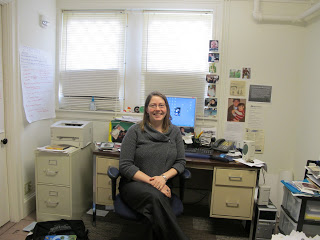
We found Cinnamon Catlin-Legutko, CEO of the Abbe Museum,
researching and writing grant applications in her office.
The Abbe Museum is closed for the month of January, but that doesn't mean the work stops.  Though we may not have regular visiting hours, during the month of January we still have school groups, public programs, and special events.  But even more importantly, January is the time when we finish up tasks from the year before, and start making the preparations and laying the groundwork for a successful year ahead.  January is an important month, one that makes the other eleven months run more smoothly. 

Ever wonder what happens at the Abbe Museum when the doors are closed?  If so, then you are in luck...because this issue of Abbe Museum is dedicated to a behind the scenes look at Bar Harbor's quiet time.

For example, Cinnamon Catlin-Legutko, CEO of the Abbe Museum, had this to say: This time of year, my work as CEO is focused on planning and writing - planning events, initiatives, and meetings and writing grant applications, policy, and organizational messages. My keyboard gets a workout so that when the weather changes and the island welcomes summer visitors again, I'm ready to meet new people, connect with Abbe friends, and be part of the exciting events, programs and exhibits we produce each year.  All our plans are in place and our implementation a success because of the rigorous work we do in the winter.  

We found JB working at the file cabinets.
John Brown, Director of Finance and Administration, has been busy wrapping up the financial happenings of 2011.  He has also been leading the search to find new software that will update the Abbe Museum's aging systems.  What will this mean for our visitors?  The new software should help us provide a more seamless experience for friends and members of the Abbe Museum and keep us on top of current technological trends.


What are others doing at the Abbe Museum this January?  Read on to find out!
Read More
Abbe Museum Abbe Museum

Development: Behind the Scenes at the Abbe Museum


We found Hannah chatting away, making sure the Abbe's
upcoming programs and activities
were included on summer event calendars.
Hannah Whalen, Director of Development

In January, it’s usually a little chilly in my office upstairs at the Abbe Museum.  Armed with a sweater and a cup of hot tea, I set to work on the computer, planning and strategizing for the upcoming year of Fundraising and Development work at the Abbe.

The budget has already been determined for 2012 and I need to make sure that we have an organized approach in order to meet our annual fundraising goals.  I recently finished the Development Plan for 2012 and the accompanying tracking system that we use internally to make sure we stay on pace with our mailings, membership, sponsorships, donor visits etc...

 Right now, I am working on a comprehensive list or specific “menu” of ways that one can support the Abbe.  Programs, people and projects are what the “giving menu” is based upon and it will include things like support for: exhibits, events, educational programs, collections care, acquisitions fund, facility care and the people who make it happen.  When I visit with donors, I like to bring them news from the Abbe and learn more about who they are, what they are interested in and why they support the Abbe Museum.  This “menu” will be something that I will be able to share on my visits when it is appropriate. Part of my job is to be a match maker between the donor and the Abbe; I work to find funding opportunities that match a person’s interests or passion.  I can then tailor a specific proposal for them. When a match is made, it is exciting and deeply satisfying for both parties.

It seems like the summer is light years away, but it will be here before we know it.  We are already planning for the Gathering Gala, which happens on July 18th this year.  My job is to garner sponsorship support for the Gala and I am working with Astra to organize the mailing list and get the letters out to potential sponsors.  Meanwhile, we are planning our second annual winter gathering for Gala artists, sponsors and Abbe volunteers.  This is way to thank our local community members for their support in the off-season, when we have more time to get together.

There is plenty more going on, but I am going to get another cup of tea and turn my focus to the “giving menu” and other Development-related duties.  Thank you for your interest in the Abbe Museum and for supporting our on-going effort to inspire new learning about the Wabanaki Nations with every visit.
Read More
Abbe Museum Abbe Museum

There's never a dull moment...

Raney Bench, Curator of Education


Raney Bench, Curator of Education

The fact that the Abbe Museum is closed to the general public over the month of January has little impact on the day-to-day work of the education and exhibition departments.  In education, I am still available to teach school children, both here at the Abbe by appointment, or traveling to classrooms in schools throughout the state.  This month I will be training two new educators in preparation for spring field trips, to help us accommodate students during our busiest months of May and June.  I will also be working with schools on Mount Desert Island and Deer Isle, as well as 10 outer Islands, on programming related to the Big Read and the Adventures of Tom Sawyer.  In preparation, I will create a new program on stereotypes about Native Americans, seeking their source and reasons why they endure through the characterization of Injun Joe. 
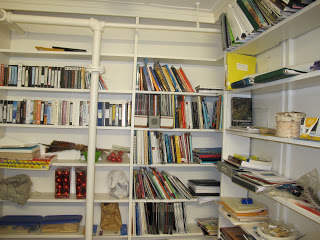
The Abbe continues to offer programs for adults and families throughout the winter, and January is a time to plan for upcoming summer programs.  The annual Brown Bag Lunch series will kick off on January 19th, focusing on "what happened next" after the exhibit Indians and Rusticators leaves off Island history in 1920.  Historian Bill Haviland will speak about the Wabanaki and their role on the cost of Maine after the end of the encampment era, and additional lectures will be held in February and March.

Today we found Raney busy in her office, researching for
some upcoming presentations and programs.
And, knowing that in a year, Indians and Rusticators will come down, we are preparing the next exhibit Wabanaki Guides.  I am working with tribal historians from the Penobscot and Passamaquoddy communities, developing the budget and exhibit plan, and starting the research phase of this exhibit, which will open in February 2013.  All in all, January is a satisfying month in which we can focus on upcoming projects and host events that connect us to our year-round community.
Read More
Abbe Museum Abbe Museum

Archaeology is not all in the field...
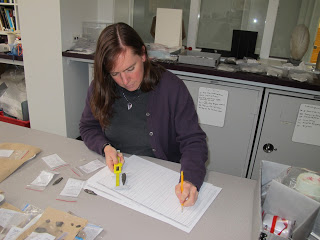
Julia Clark, Curator of Collections

Julia Clark, Curator of Collections
Work in the Wellman Archaeology Lab is as busy as ever during the winter months!  Star volunteers like Jean Rohrer and Donna Murphy work on washing, sorting and cataloging the artifacts collected during the Abbe's archaeological field school. Every now and then they discover some little treasure or anomaly that was missed in the field, and I hear an "Oh, cool!" from the other side of the room. 

Meanwhile, Jane Clifton, who you may encounter in the Abbe Museum Shop when we are open, is tackling several projects in the Lab. She spent part of December sorting through exhibition records, copying the most important documents onto archival paper, and sorting into archival file folders and boxes- making the necessary transition from the museum's working files to the archives. During January, Jane is copying more than a decade of archaeological field school records onto archival paper and re-filing them in archival folder, important steps towards the long term preservation not only of collections, but of the very important records that go with them. Both archival projects are funded by grants from the Maine State Archives.
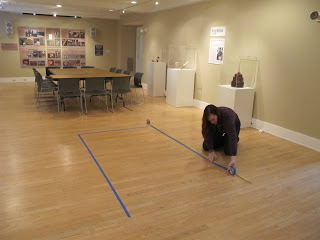

Today we found Julia laying out measurements
for an exhibit that will open at the Abbe next winter.
Many of my tasks during these winter months revolve around catching up from last year and getting prepared for next year. I just finished my annual wrap-up of new acquisitions, compiling a list and checking it against the necessary paperwork. I want to make sure I have all the correct documentation, such as the Deed of Gift which officially transfers ownership to the museum.  I will spend some time entering data on the past year's acquisitions into our collections management software, PastPerfect. This is also a good time to check in with researchers who are working with Abbe collections or archives, making sure they have what they need and providing it if they do not. I will also be working on upcoming exhibits- finalizing budgets and working with Cinnamon to secure funding; working with guest curators to create content; working with Maine Indian Education to create the 2012 Waponahki Student Art Show- all fun and rewarding.
Read More
Abbe Museum Abbe Museum

My January started with this blog entry....

We found Astra showing off signs
for the new text to join program.
Astra Haldeman, Manager of Museum Services 


A lot of what I will do this month is all about keeping friends of the Abbe connected and informed.  I start each month working on our blog and monthly eNews, making sure that everyone is aware of what is happening at the Abbe Museum in the upcoming days and weeks.  Yesterday, I set up a new way for visitors subscribe to Abbe eNews - You already receive these newsletters, so you'll miss out on this fun, but new subscribers can text abbemuseum to 22828 and instantly be added to our mailing list.  If you want to try it out, it's quite fun...you'll just receive an email thinking that you've changed your email preferences. 

I am also beginning a separate, short newsletter for volunteers that will be sent each month after eNews, sharing that month's volunteer opportunities.  If you would like to receive those emails, please let me know (astra@abbemuseum.org) or sign up for the list by selecting the "Update Profile/Email Address" link at the very bottom of this email.  My goal for 2012 is to keep everyone connected! 

Next month is actually the one-year anniversary of Abbe eNews, so I'd love to hear your feedback.  Please let me know if there are other sorts of articles you'd be interested in reading are, what your favorite aspects of eNews are, and any suggestions you might have for improvement.  We want Abbe eNews to be easy, interesting, convenient, and enjoyable for all our readers.

Throughout January I'll focus on the winter and the summer season simultaneously.  2011 was the tenth anniversary of the Abbe Museum Downtown, and for the 73 years before that the Abbe had never been open in the winter...so we still find ourselves reminding everyone that we are here!  I'll attend meetings and meet other Bar Harbor Merchants interested in promoting Bar Harbor as a year-round destination, and we'll begin planning activities for both this winter and next. 

At the same time, I'll start prepping for this coming summer.  Applications for seasonal positions in guest services will be available on our website by the end of this month, so please direct anyone who might be a good candidate to take a look.  We'll collect the applications and begin the hiring process early this spring.  January is also a great time for me to begin researching new products for the Abbe Shop.  Because we are closed now, purchasing won't begin until March or April, but by the end of this month I'll have a good idea about which books, souvenirs, and other fun take-aways you might expect to see this summer.

Then of course there are all the normal housekeeping tasks; membership reminders and thank yous, updates from our 2011 Guest Book, planning for the Gala...but I'll stop chatting here and let you read on about what others are doing!
Read More
Abbe Museum Abbe Museum

Other News & Events for January

There is always something happening at the Abbe, and this fall and winter are no exception!  Please visit our  online calendar for more details.

If you are in the MDI area this month, make sure to visit us on Thursday, January 19 for the first discussion in our second annual brown bag lunch series.  This year's series will explore topics related to our blockbuster exhibit, Indians & Rusticators.  The first discussion will be led by historian Bill Haviland and is titled: Indians & Rusticators: What Happened Next?  Bring your lunch and join us for this free event from noon-1pm.


Other events and demonstrations will follow soon thereafter, so make sure to mark your calendar now! 
There are also a number of upcoming Wabanaki events that are open to the public.  The following links are a sample of some upcoming activities and recent articles that may interest you.  Know of more?  Feel free to post them on our Facebook page!

The Wabanaki Scholars Series (Minsky Hall, University of Maine Campus) continues January 19, 2012 with presentations by Sherri Mitchell & Bonnie Newsom, followed by discussion and light refreshments.
The series is co-hosted by the Wabanaki Center and the Penobscot Cultural Historic Preservation Department.  Next month's presentation will take place February 2nd with Maria Girouard & Suzanne Greenlaw.

First Maliseet Legislator of Maine Sworn In, article from MPBN

It Didn't Go Away in 2011: Racism Continued, article in Indian Country Today

Reflection on Native American Heritage Month (November), from the Marines Website

Pow Wows in Literature, New Book includes a CD in English & Micmac, from Indian Country Today

Life of Mattie Mitchell highlighted in new book, article in The Western Star

December 2011 Retrospective from Indian Country Today

First Nations: A 2011 Retrospective from Indian Country Today

MIBA Events 

Tribes of the Dawn Land Cultural and Heritage Days for 2012
Read More
Abbe Museum Abbe Museum

A Decade of Gratitude

by Hannah Whalen,
Director of Development

As we reflect on the end of a year of celebrating our first decade in downtown Bar Harbor, there is much to be grateful for at the Abbe Museum.  The hundreds of people who, ten years ago, participated in the Campaign to Bring the Abbe Museum to the Community made it happen! Many things that could not have even been imagined then, are now possible because of this beautiful new facility.

There are intangible moments; consider what a Wabanaki child experiences when she visits the Abbe for the first time and sees her artwork framed and hung on a gallery wall next to the works of other young Wabanaki students.  The Waponahki Student Art Show is an annual spring tradition and over its 10 years downtown, more than 400 young people have delighted in seeing their art on display at the Abbe.
 
Watie Akins performing in the Circle of the Four Directions
Some of you may recall that during the planning phase of the building, the Abbe consulted with Native communities in Maine, seeking their ideas for design.  Again and again they said that there needed to be a circle somewhere in the building.  The circle is an important symbol in Native culture and represents continuity and wholeness.  With the guidance of Wabanaki advisors - especially engineer, Watie Akins, Penobscot, and through the generosity of John and Ruth Overton, who named the Circle of the Four Directions in memory of John’s mother Joan Blair Overton - the Circle was constructed on site.  The roof is slanted and faces east toward the rising sun.   The walls are made of fir paneling and the floor is white ash and often there is Native flute music in the background.  Over the years many guests have commented that they enjoy just sitting in the Circle and the peaceful, calm feeling it ensues.  

The word philanthropy means, “the love of humankind.” Every year our donors demonstrate their philanthropy for the work we do at the Abbe.  Thanks to our donors, members and volunteers, we are able to inspire new learning about the Wabanaki Nations for the 25,000 who visit us every year.  Because of our contributors, we are able to properly care for over 50,000 historical objects, including the largest and best documented museum collection of Wabanaki basketry.  And with the Abbe being downtown, we can now offer year-round exhibitions and educational programs that tell the story of the Wabanaki.

Ten years later, we truly have achieved “neke naka toke” (Passamaquoddy for “the best of both worlds”) by having a-state-of-the-art downtown museum with exhibitions and programs year round, and the historic Abbe at Sieur de Monts Spring open seasonally.

Thank you for your interest in the Abbe Museum and for your support. Happy Holidays!
Read More
Abbe Museum Abbe Museum

Other News & Events for December

There is always something happening at the Abbe, and this fall and winter are no exception!  Please visit our  online calendar for more details.  

Crafts and fun at the 2010 Holiday Open House.
If you are in the MDI area this week, make sure to visit us on Thursday, December 1st for the free screening of  
Off the Rez which will begin at 7:00.


Other events and demonstrations will follow soon thereafter, so make sure to mark your calendar now! 

There are also a number of upcoming Wabanaki events that are open to the public.  The following links are a sample of some upcoming activities and recent articles that may interest you.  Know of more?  Feel free to post them on our Facebook page!

  • Leon Sockbeson II, whose work is currently featured in Twisted Path II, recently placed #11 in a national contest in which over 600 gown designs were submitted to Adrianna Pappell.  This placement qualifies Leon’s design for the second round of the competition; a judging panel will select and produce 5 dresses for another round of voting.  Visit http://eandadriannapapellpromotion.com/contest/ for more information on the contest, or to be involved in the next round of voting.  
  •  A Boston Globe Travel article featuring the Acadia Region had some lovely comments about the Abbe Museum.  Read it here. 
  • "Many Hands: Wabanaki Paths of Learning," is an art exhibition currently on display at University of Southern Maine (Woodbury Campus Center), Portland through Dec. 16.  Click here to read about the opening. 
Read More
Abbe Museum Abbe Museum

Last Film in the 2011 Series

The last film in the Abbe Museum's 2011 Native American Film Series will screen Thursday, December 1st from 7:00 -- 9:00.

Join us to watch Off the Rez, which will be followed by a discussion moderated by Raney Bench, Curator of Education.

Off the Rez is the story of Shoni Schimmel.  Shoni was a high-school junior living on the Umatilla Indian Reservation in Oregon, the star basketball player on the local team. Then Shoni's mother, Ceci Moses, took a job coaching a high school team in Portland, and against the wishes of her own mother and grandmother on the "Rez," Ceci brought Shoni and her seven other children with her. Now, Shoni's senior year has become the most important year of their lives as mother and daughter fight to prove that Native American women can become champions off the Rez.

For more information about this film, please click here.

The Abbe Museum's third annual film series brings important contemporary films by and about Native people to Bar Harbor. Filmmakers and scholars lead panel discussions following each film. Films are screened in the Community Gallery at the Downtown Abbe Museum, 26 Mount Desert Street, and are free and open to the public. For more information about the film series, visit www.abbemuseum.org.


Read More
Abbe Museum Abbe Museum

Holiday Sales & Events


As you prepare for this holiday season, don't forget there are a number of events at the Abbe Museum perfect for family and friends to enjoy!  For more details visit our calendar, but here's a quick reminder on some upcoming holiday activities (some newly added since the November issue of eNews!):

Events

--December 2nd, 8pm-Midnight: Stay up late for the Village Holidays & Midnight Madness Sale! From 8pm-Midnight the Abbe will be open with more special holiday sales. Enjoy a classy night on the town and shop in your evening wear for discounts up to 25% in the Abbe Shop!

--December 10th, 10am-7pm:  The Abbe Museum will take part in the Bar Harbor Merchants Association's Holiday Open House.  Stop in between 10:00-4:00 to enter your name in a raffle for a Household Membership to the Abbe Museum, and other great prizes from Bar Harbor Merchants.  The Membership Lounge will be open to all visitors throughout the day, so if you haven't seen it before come in and check it out, relax, and enjoy a warm drink!  Then, from 4:00-7:00 admission to the Abbe Museum will be free as the Bar Harbor Merchants arrive to start the holiday festivities!  There will be refreshments, raffle winners will be announced, Santa will be in the Circle of the Four Directions for pictures, and special guests from Sherman's Books & Stationary will be reading new their holiday books for kids!  This event is sponsored by the Bar Harbor Merchants Association, promoting four season fun in Bar Harbor, and hosted at the Abbe Museum.  Visit their webpage for more details by clicking here.

--Don't forget to visit the Abbe Museum Booth to chat with Curators Julia Clark and Raney Bench, as well as Abbe CEO Cinnamon Catlin-Legutko, at the Maine Indian Basketmaker's Alliance sale and demonstration hosted by the Hudson Museum in Orono on December 10thClick here for more details, and that day's schedule of events.

--December 11th, 1pm-4pm: Join us for the Abbe Museum Annual Open House!  This is the perfect time to enjoy our new exhibits and take home some souvenirs: join us that afternoon for free admission, fun and unique crafts to make and take home, and light refreshments!


Sales

Looking for the perfect gift?  
Throughout December visit the Abbe Shop for 20% OFF!


Need something last minute?
The Abbe Shop is participating in Wrapped & Ready to Go!  Quickly step inside and leave moments later with a pre-wrapped gift for everyone on your list!


Want something for the person who has it all?
Abbe Museum Memberships are the perfect gift that keeps on giving...all year long!  Every level of membership is available; just ask for it to be wrapped for the perfect holiday presentation!  Wrapped memberships can be purchased at the Abbe Shop, or we can mail them to your special someone...just give us a call or email astra@abbemuseum.org for more details.
You can also make a donation in honor of friends or family this holiday, and we'll send them a special card to share our thanks!
Sample Gift Membership Insert

Read More
Abbe Museum Abbe Museum

An adorable little ridged hammerstone from the Stephen Wheatland Collection


Julia Clark,
Curator of Collections

Adorable little ridged hammerstone from the Stephen Wheatland Collection
Over the last few years, long-time Abbe trustee and friend Alice Wellman has been sorting through and cleaning out her and her father’s archaeological collections. Her father, Stephen Wheatland, collected a variety of artifacts, starting in the 1930s, along the shores of Sorrento where the family spent summers and the lakes and rivers of northern Maine where he worked, fished and hunted.  Alice followed in his footsteps, and over the years took part in or led several Abbe Museum excavations, from Eastport to Aroostook County.  The Wellman-Wheatland archaeological collection now resides at the Abbe, where it will be taken excellent care of and made accessible in perpetuity.

The most recent batch of artifacts, re-discovered on a shelf in Stephen Wheatland’s boathouse in Sorrento, included this wonderful little hammerstone.  I was immediately charmed by it! (Oh, yeah, I immediately called it adorable!) Only 9 cm long, it is made from a small chunk of dark gray chert, possibly originating from the Munsungan Lake/Norway Bluff formation in northern Maine.  The chunk of stone was worked by a Wabanaki ancestor into just the size and shape they wanted. It was then used to hammer something, probably to create other stone tools, so that its carefully shaped edges developed the fine battering we can now see.

Why so small? Maybe the tool maker had little hands like mine. Maybe they needed a precision tool. I also wonder why it was discarded. It’s not broken- in fact it looks perfect!  Perhaps it just got too worn out to use. Whatever the case, it was discarded, and hundreds to thousands of years later, Stephen Wheatland picked it up of the shore in the 1950s, and eventually it made its way here to the Abbe.  What a little gift for a quiet November week in the Archaeology Lab.

Read More
Abbe Museum Abbe Museum

Help us reach our goals!


Dear Friends,

All year we celebrated our 10th anniversary in downtown Bar Harbor, and it has been a flurry of activity!  Here are a few highlights from this exciting time at the Abbe Museum:
  • We opened a major exhibit in July, Indians & Rusticators, which attracted new visitors and helped us to reconnect with friends.
  • Visits to the Abbe are up nearly 15% from last year.
  • We taught over 3,000 school children at the Abbe and inside classrooms; and, we trained 100 Maine teachers on how to meet the unfunded state mandate (L.D. 291) that requires K-12 students to learn Wabanaki history in the classroom.
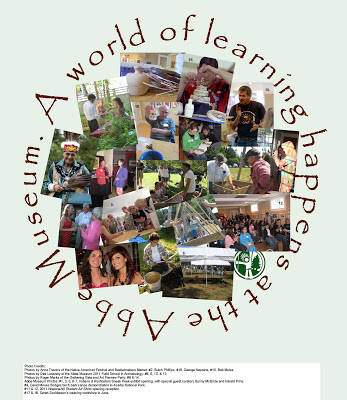
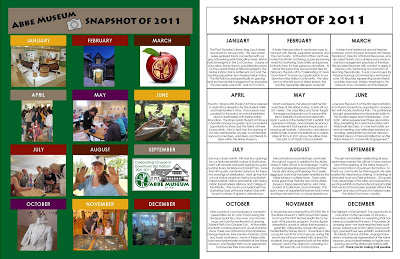
As with the cycles of the seasons, the work at the Abbe continues: designing, planning, building, installing and deconstructing exhibits; hosting educational workshops, teacher trainings, teaching children, engaging with thousands of learners from around the world; providing constant care of the collections; and, organizing yearly events such as the Abbe's Archaeology Field School.  This annual work requires funding and your support makes it all possible. 

As you consider your end of year giving, please remember the Abbe Museum.  Every gift made to the annual appeal, no matter the amount, truly makes a difference and your generosity will help to ensure that the Abbe can continue to change lives through learning.  Thank you for your consideration.  Click here to learn more.

Sincerely,

Cinnamon Catlin-Legutko

P.S.  I hope to see you this winter at the Abbe!
click to enlarge

Read More
Abbe Museum Abbe Museum

Thanksgiving Revisted

Raney Bench, Curator of Education


“Considering that virtually none of the standard fare surrounding Thanksgiving contains an ounce of authenticity, historical accuracy, or cross-cultural perception, why is it so apparently ingrained?”

--Michael Dorris Why I’m Not Thankful for Thanksgiving 1978


How many of us learned in school that Pilgrims settled in New England, had a rough time making a go of it, and were assisted in their cause by a friendly Native named Squanto? Or, alternatively, they found a pristine wilderness and in trying to learn how to survive, they found help by friendly Squanto. Either way, in gratitude for Squanto’s help, at the first harvest, the Pilgrims invited the Indians for a feast of thanks and friendship, the likes of which the Indians had never seen. If your school was like mine, you learned this while making “authentic” Pilgrim hats with silver buckles, or construction paper feather headdresses and reenacting the event in a play.


The real story, however, is a little bit different. Prior to the arrival of the Pilgrims, Squanto had been kidnapped and taken to Europe, where he learned English. He escaped and returned to New England to find that his entire village had been wiped out by disease. Squanto began working with the Pilgrim colony for his own survival, as much as for theirs.


As James Loewen points out in his book Lies My Teacher Told Me “our archetypal image of this first Thanksgiving portrays the groaning boards in the woods, with the Pilgrims in their starched Sunday best next to their almost naked Indian guests.” (pg. 94) The common suggestion that Indians had never seen such a feast, despite that it consisted of primarily Native foods, continues to marginalize Indians and the role they play in the history of the Americas.


The real story is that Thanksgiving was not introduced by the Pilgrims. For centuries now, each fall Native communities throughout the Americas have been hosting feasts of thanks with the harvest. Our modern celebration began in 1863, when Abraham Lincoln proclaimed it a national holiday, and it wasn’t until the 1890s that the Pilgrims were included in the myth.


It is a welcome break from our hectic lives to sit together as a family, group of friends, or community, and reflect on our blessings and enjoy a shared meal. This is the true story of Thanksgiving- gratitude for the bounty in our lives and honoring of the diverse traditions that create the fabric of our country.

Read More
Abbe Museum Abbe Museum

Winter is Here!?!


Downtown Bldng with Logo and snow effects

The surprising snow storm that blew in this past weekend reminded us that winter is just around the corner (or perhaps already here!), and so we'd like to thank everyone for a successful summer and fall. The 2011 season was a busy one for the Abbe Museum, and we could not have done it without your support...thank you!


We are now on our Winter Schedule, which will be in effect until

May of 2012:

Museum Galleries & Shop Open:

Thursday, Friday, & Saturday, 10:00 -- 4:00

Abbe Museum Offices Open:
Monday -- Friday, 9:00 -- 4:00

Please be aware that if there is inclement weather, the Abbe Museum will be closed if MDI Schools are closed. If it is a weekend day or you are unsure, it is always best to check: please call 207-288-3519 before making the trip. The Abbe Museum at Sieur de Monts is closed for the winter; the above hours refer to the Downtown Abbe Museum at 26 Mount Desert Street, Bar Harbor.


There is always something happening at the Abbe Museum, and winter is no exception. Please visit our website or call for our ever-growing list of Winter Programs. Confirmed programs are listed at abbemuseum.org, but there are still more we hope to add!

Winter is also a popular time for school group visits to the museum, as well as bookings for Abbe Educational Programs which can be delivered in the classrooms. If you are interested in visiting the Abbe or having the Abbe visit your school or organization (adult programs can be arranged too!) please browse through the offerings on our website, or contact Raney Bench, Curator of Education.


Click to learn more about School Programs or Outreach Programs for Children & Adults.

Read More
Abbe Museum Abbe Museum

Upcoming Holiday Events


The Holidays are fast approaching, and there are a number of events at the Abbe Museum to help you celebrate!

The date is set for our Annual Holiday Open House: Sunday, December 11th from 1pm -- 4pm. Join us that afternoon for for free admission, fun and unique crafts to make and take home, and light refreshments.

There are also exciting Bar Harbor festivities that the Abbe Museum is proud to take part in.

On Saturday, November 12th, wake up early and stay in your pajamas to enjoy the 17th Annual Early Bird Pajama Sale & 4th Annual Bed Races. We'll be open from 6am (yikes!) to 4pm, with special sales, coffee, tea, and other treats from 6am-9am to help keep you going...

Then on Friday, December 2nd stay up late for the Village Holidays & Midnight Madness Sale! From 8pm-Midnight the Abbe will be open with more special holiday sales. Enjoy a classy night on the town and shop in your evening wear!
Read More