Updating "Layers of Time"
I just had the pleasure of meeting Dr. Arthur Spiess, PhD., Senior Archaeologist at the Maine Historic Preservation Commission who also works at the Abbe Field Schools. I have read many of his field notes while Zach and I have been planning our exhibit about the Ewing-Bragdon dig site, and I was looking forward to having the opportunity for him to look at the work we had done so far.
He is a friendly and enthusiastic guy, and he was able to offer some great feedback for the new addition to Layers of Time. Listening to him speak, I realized what a vast and expansive field archaeology is. It was only seventy years ago when Wendell Hadlock first excavated the Ewing-Bragdon site. At that time it was the bigger, easier to spot artifacts that they were searching for to answer questions about the past. Now, with advances in technology, we are able to use much more of what we find at sites to continue piecing together the history of the land.
By sifting through soil samples we are able to find things like shell beads, a piece of copper, and tiny bones. All of these were previously overlooked, but thankfully we got a second chance! The shell beads tell us there was free time for recreation. The copper indicates trade and metalworking. The bones clue us in to what was being hunted. Even the soil itself tells a story.
Archaeology brings us a little bit closer to our ancestors and helps keep the past connected to the future through the answers it provides. On the other hand, it is also interesting to think about the questions that can only be definitively answered by people who were alive thousands of years ago. Working on the Layers of Time exhibit and learning more about archaeology has been a great exercise in balancing science with mystery.
Recent Acquisition: Miniature Wigwam

In early January, I was perusing on-line antique and auction web sites when I came upon this little gem. I like to check out these sites periodically to see what types of Wabanaki material is on the market, and to help identify gaps in our collection. This wonderful piece jumped right out at me in that respect!
As many of you know, the Abbe Museum has over 1000 ash and sweetgrass baskets in our collection, but none like this 7 inch tall vignette. I have seen some of the individual parts, and I have seen similar scenes created with birchbark. I shared photos of this particular piece with other experts in the field. While we all agreed we had never seen anything quite like it, we also agreed that it was probably Passamaquoddy or Penobscot work from the early 20th century. I can envision a summer visitor purchasing this at a Wabanaki encampment on the coast of Maine to take home as a souvenir of their visit. And as Passamaquoddy historic preservation officer Donald Soctomah said, "What a nice weaving story."
With the generous support of trustee John Benson, the Abbe was able to acquire a new treasure for our permanent collection.
New Program Initiatives at the Abbe Museum

The 2011 calendar includes several new programs, themes, partnerships, and series, which have been really exciting to develop. We started the year with some in-house programs focused around our Headline News: Wabanaki Sovereignty in the 21st Century exhibit, which includes a brown bag lunch series and an evening lecture on federal Indian policy scheduled for April. This is a new focus for the Abbe, and the lunch series is a new winter program offering. The attendance for these programs has been wonderful, and this series, as well as other winter programs, will continue to be offered for our year-round residents.
The Abbe is partnering with Acadia National Park to present a series of Wednesday cultural demonstrations at various locations in the Park. The demonstrations include musical performances, ash pounding, and birch bark canoe demonstrations. Check the Abbe Museum on-line calendar for locations and details on these programs.
Thanks to the generous support of Bar Harbor Bank and Trust, the Abbe will be able to continue our summer demonstration series, this year focused on new and emerging Wabanaki artists. There are some very talented young artists working in basketmaking, carving, and beadworking, and it's our pleasure to bring them to the Abbe and support their work.
Over the summer we will continue our Rainy Days at the Abbe program. Launched in 2010, Abbe volunteers host games, crafts, or hands-on experiences for people of all ages on rainy days, offering an alternative for people who want to be inside on a rainy day.
In the fall we are planning our third annual film series. The Abbe has the opportunity to bring films by Native film makers, or about Native issues, to the museum for a free screening and discussion, making this series very popular.
Add all this to our regular schedule of workshops, lectures, family programs, and exhibits and there is always something going on at the Abbe! For up-to-date information, times, locations, and more events, check the Abbe's on-line calendar here.
Spend Some Time With Us
Many of the events here at the Abbe Museum are volunteer-powered, including our next two events Craft Day at the Abbe Museum and March on Mount Desert. Volunteers also make new program initiatives possible, such as Rainy Days at the Abbe. Last year volunteers logged over 1,000 hours at the Abbe Museum leading activities, greeting visitors in Guest Services, conducting tours and educational programs, inventorying the library, helping in the offices, working in the archaeology lab, writing artist biographies, preparing hors d'oeuvres, and acting as hosts and hostesses at events.
We would like to take this opportunity to thank all the dedicated volunteers who help to make the Abbe Museum such a special place. As we celebrate our 10th Year in Downtown Bar Harbor we are grateful for all the hard work that got us to where we are today. Thank you!
There is always something happening at the Abbe Museum, and there is always a way that you can help! If you are interested in learning more about volunteering at the Abbe, please visit here. Benefits of volunteering at the Abbe Museum include earning experience in the museums field, the opportunity to become involved more closely with a community-oriented non-profit, and, as a thank you, $1 in Abbe Bucks for every hour you volunteer with the Abbe (Abbe Bucks are redeemable in the Abbe Shop). Together we can find a way to match your skills and interests with our needs.
Abbe intern Rachel Heasly reports on a workshop
College of the Atlantic student Rachel Heasly is interning with Raney Bench this term, working on education projects and a small exhibit. Recently Rachel attended a teacher workshop in Bucksport, and filed this summary:
There is nothing particularly exciting about Bucksport in February (and I’m writing that as a Bar Harbor resident), but when you haven’t been off of MDI in weeks, the idea of leaving the island for a new town, even if it is just as quiet, is oddly appealing.
So when Raney told me she was going to be leading a teacher’s workshop in Bucksport, I jumped at the chance to tag along.
The workshop was attended by elementary school teachers from Bucksport, who taught Pre-K through fourth grade. This meant that Raney focused her presentation on more kid-friendly resources, such as CDs, sheet music, and picture books. However, she certainly did not stop there. All the resources covered ranged from totally kid friendly to more teacher and adult appropriate. She also went over four valuable websites that featured a lot of free content including lesson plans and curricula.
After the presentation, many of the teachers confessed that they had not begun teaching their students about the Wabanaki, and that they appreciated the opportunity to see just how easy it can be to jump in and start.
I cannot say I was surprised to hear that none of them had started teaching about the Wabanaki, despite the state requirement that all teachers must do so. I grew up in the Portland public school system, and not one lesson in any of my classes, from kindergarten through twelfth grade, even touched upon the Wabanaki. It was not until a class trip to the Abbe Museum while I was at College of the Atlantic that I even learned what the term “Wabanaki” meant.
During my time in Bar Harbor I have been privileged to learn more about the Native people of Maine by becoming involved with the Abbe. And now that I am an intern here, I am learning first-hand how important it is that all students in this state be educated about the 12,000 years of history the Wabanaki have here, as well as the very palpable presence they still have in this state.
The first time I came to the Abbe I immediately felt eager to learn about the four Native tribes of Maine. And it seemed to me that the teachers of Bucksport were feeling the same kind of excitement. With all the resources available to them, why wouldn’t they be? Perhaps a Wabanaki unit could be just the thing to brighten a student’s dull winter day.
Archeology: from an intern’s point of view
 Whalen, and I am a College of the Atlantic student who is interning at the Abbe this winter. I have been working with the archeological collection from the 2009 field school at the Ewing Bragdon site. The work so far as has consisted of lots of washing bags and bags of stone flakes, pottery shards, shells, and bones. Once a bag is cleaned, it is then cataloged; re-bagged, and put in file box to be accessed later.
Most of the work is cleaning garbage, albeit 1000 year old garbage, but still it’s the leftovers and scraps that were discarded as waste. Now it gives us a window into the way life was lived back then by seeing what was eaten, what was made, and what was discarded. By looking at the old bones, we can see what kind of animals were eaten or lived in the area. By looking at the temper in the pottery, we can see what resources they were using and date how long ago they were there. Looking at the stone flakes and broken tools, we can see the types of stone they had and methods that were used to make tools.
There is so much that can be learned from sorting through the trash, and it makes me think about what an archeologist will find in 1000 years when they look at our trash? But that question also worries me. The people who lived here before us lived with the land and used what was here to live their life, and it is only because of the shell middens’s preserving qualities that anything is left. Whereas, if you look at our landfills in a 1000 years’ time very little will have changed – the plastic, Styrofoam, and glass will all still be there waiting for the new archeology intern to wash and short it…
Celebrate 250! Community Dinner
- Concepts of land ownership are cultural. Wabanaki people practiced shared use of land and resources, and initially, they agreed to share these resources with Europeans. Europeans wanted individual title to land for exclusive use - thus conflict ensued. There are many other, and more complex reasons, why conflict over land occurred, but the realization that land ownership is cultural can help us understand history in new ways.
- We have archaeological evidence that Native people were living on the coast during the winter and the summer. Generally, people have believed that Native people were living on the coast in the summer and moving inland for the winter. This is certainly true after European contact, but evidence from the hinges of clam shells says otherwise. Clam shell hinges grow rings like trees, two each year, one in the summer and one in the winter. By looking at these rings, we can tell when the clams were harvested- and many were collected and processed in the winter.
- There are historic records that also indicate winter habitation by Wabanaki people on Mount Desert Island. In the 1840s, Adelma Somes wrote in her journals of Penobscot encampments on many of the fresh water ponds and lakes on the Island, and that in the winter the tribe put on performances for the residents that were well attended. Her diary, and more information about this relationship, will be explored in our new exhibit Indians and Rusticators which opens July 8, 2011.
Hope to see you all at the Abbe- our next program is Thursday January 20 from 12:00-1:00- a brown bag lunch and learn series on sovereignty- for more information go to our website calendar of events at www.abbemuseum.org.
New blog about this year's Field School!
Abbe Museum hosts 4th Annual Community Open House and Cultural Connections Program Series

Bar Harbor, ME - June 13, 2010 – The Abbe Museum is hosting our 4th annual Community Open House, a day that includes free admission to both our locations, and demonstrations, activities, and crafts at the museum in downtown Bar Harbor.
Whether looking for an opportunity to explore the museum and browse the newest exhibits, Headline News: Wabanaki Sovereignty in the 21st Century and the 2010 Waponahki Student Art Show, or looking for a Sunday outing the whole family can enjoy, make sure to mark the calendar for June 13th. Stay the whole day or plan a visit around any of the unique programs available at the downtown Bar Harbor location:
--From 10:00 to 12:00, nationally renowned drum group Rez Dog Singers will kick-off the fun with their spirited pow wow style music in the court yard of the museum. The group’s energetic performances always enliven the Abbe Museum, where they have performed multiple times. Rez Dog Singers musical group is comprised of young men from Native American communities throughout New England.
--From 1:00-5:00, as part of our Cultural Connections series, funded in part by Bar Harbor Bank and Trust, Butch Phillips, Penobscot, will be presenting the art of building a birch bark canoe with a video and canoe display. Butch Phillips will display both his finished canoe and examples of the materials he needed to construct it, and will be available to discuss the process with visitors in an informal manner. A video on the process of building a canoe will be presented as well, so visitors can see first hand how this ancient craft has been revitalized.
--From 1:00-3:00, museum volunteers will offer hands on activities to engage visitors of all ages, including crafts, artifact exploration, and storytelling.
Visitors are also welcome to explore the original Abbe Museum, located at Sieur de Monts Springs in Acadia National Park. This historic location has been welcoming visitors since 1928. For more information call Raney Bench at 288-3519.
The mission of the Abbe Museum is to inspire new learning about the Wabanaki Nations with every visit. The Abbe has a collection of over 50,000 archeological, historic and contemporary objects including stone and bone tools, pottery, beadwork, carved root clubs, birch bark canoes, and supporting collections of photographs, maps, and archival documents. It holds the largest and best-documented collection of Maine Native American basketry in any museum. Its collections conservation program is recognized nationally as a model for museums.
Contact Person: Raney Bench, Curator of Education
Abbe Museum
288-3519
educator@abbemuseum.org
26 Mount Desert St.
Bar Harbor, ME 04609
###
Enroll in the Abbe Museum Archaeology Field School Today!

The Abbe Museum, well known for conducting outstanding archaeology programs, is offering its annual archaeological field school the week of August 1-6, 2010. Participants will work with Maine State Archeologist Dr. Arthur Spiess on the Tranquility Farm coastal shell midden site in Gouldsboro, Maine. Field school participants will conduct excavations, practice mapping the site, and learn about the analysis of artifacts.
The 2010 excavation will build on previous discoveries at the site, including a house floor and hearth feature that date to about 1200 years ago. Burned plant remains from the hearth include raspberry, chenopodium, smartweed, wild rye and dewberry. A variety of pottery, stone tools and bone tools, as well as food bone remains, are plentiful at the Tranquility Farm site.
Fieldwork will be complimented by lab sessions and lectures to give participants a broad understanding of archaeology and Maine's Native American heritage.
Participation in the field school is open to the public and no previous archaeological experience is necessary, but enrollment is limited. The cost is $350 for Abbe Museum members and $400 for non-members. Participants will be responsible for their own lodging and food.
Scholarships are available to Maine Native Americans and high school or college students from Maine, with preference given to residents of Hancock, Washington, Penobscot and Aroostook Counties. The scholarship covers the cost of tuition and includes a stipend towards lodging and meals. Applications for the scholarship must be received by June 15, 2010.
Scholarship applications and registration information are available on the Abbe Museum’s web site at www.abbemuseum.org, or by calling the museum at (207) 288-3519. You must be 17 or older to participate.
CLICK HERE TO DOWNLOAD APPLICATION
Contact information:
Julia Clark, Curator of CollectionS
collections@abbemuseum.org
Abbe Museum
26 Mount Desert Street
Bar Harbor, ME 04609
(207) 288-3519
www.abbemuseum.org
Jackson Lab Family Fun Night at the Abbe Museum

The
Do you have 8 Minutes to help the Abbe?
The
Would you be willing to share about 8 minutes of your time to help us with this important survey? Our museum will greatly benefit from this study by having access to the overall results as well as the results from our visitors. We’ll be using the results to make our museum more interesting, relevant, and even fun for you and your family.
In exchange, Reach Advisors, the audience research firm administering the survey, will be selecting some of the participants to win gifts ranging from museum memberships to gift certificates to Amazon.com.
Your individual information will absolutely be kept confidential and will not be shared or used for any solicitations.
To take the survey, click on (or copy URL and insert into browser):
http://www.zoomerang.com/Survey/?p=WEB22A55PEXG2V
If you have any problems with the survey, please feel free to e-mail Susie Wilkening, of Reach Advisors, at Susie@reachadvisors.com. She is happy to help you out.
Thank you for supporting not only the
Best wishes,
Your Friends at the
Charting a New Path - The Abbe Museum Strategic Plan

Over the past two years, the Abbe Museum has been in a period of leadership transition and the organization is poised to move into a new chapter of the Museum’s story. Learn more...
Abbe Invites All to Holiday Open House

The Abbe Museum is excited to announce our upcoming Holiday Open House, to be held at our downtown Bar Harbor location. Please join us on Sunday, December 13th from 1:00 – 4:00 for a free visit to the Museum. Many exciting family oriented activities are planned for this day to celebrate our community, the holiday season and Wabanaki culture. Take part in “craft” stations where you can participate in hands on projects These projects will include weaving a star ornament, making a natural stained glass window ornament and beading a wigwam, just to name a few. Visitors will also enjoy a variety of games as well as goodies and refreshments.
The Holiday Open House is also a perfect opportunity to see our exhibit, Twisted Path: Contemporary Native American Artists Walking in Two Worlds, before it closes later this month. Visitors will also want to stop in the Abbe Museum Shop, where everything is 20% off with a selection of books at 40% off. For more information about the Abbe Museum Holiday Open House, the Museum, or the gift shop sale, call 288-3519.
Dinner and a Movie Helps Sustain Community Programs

The
Owner, Michael Boland is a long time supporter of the Abbe and a former board member of the museum. He has had a long standing commitment to preserving the environment and supporting the local economy through sustainable and eco-friendly buying and operation practices at all of his restaurants including Guinness & Porcelli's. Past president of the Bar Harbor Chamber of Commerce for 5 years but still active in many different environmental causes, Michael continues to mix a love of business, tourism and sustainability and is excited to participate in Dine & Donate with the Abbe.
Through exhibitions, educational programs, research, collections, and collaborative partnerships, the
Combining Irish Hospitality with the Flavors of Italy, located in downtown
As an extra bonus, after dinner at Guinness & Porcelli’s you can watch a free movie at the Abbe! From 7:00 pm to 9:00 pm, the Museum will screen a local documentary that explores the Penobscot tribe’s connection to their river of the same name, and the importance of maintaining its health not just for their people, but for all of
To participate in Dine & Donate simply call 288-0030 and make your dinner reservation for the evening of December 3, 2009. For more information about Guinness & Porcelli's, located at
To learn more about the
Stories Shared Through Art Help Renew Native Communities
The Abbe Museum invites the public to a discussion panel comprised of contemporary Native American artists from 3:00pm to 5:00pm on Saturday November 14th. As part of the Museum’s exhibition Twisted Path: Contemporary Native American Artists Walking in Two Worlds, the panel will be moderated by Darren Ranco, Penobscot scholar and professor at the University of Maine, Orono who states “the discussion will explore the many ways that traditional and contemporary Native art forms represent and shape who we are as Native people.”
Panel artists Watie Akins, Penobscot, Rick Hunt, Abenaki, Lenny Novak, Abenaki, Jennifer Neptune, Penobscot and George Longfish, Seneca/Tuscarora represent indigenous people from the Northeast. They will discuss the ways they use art to express their personal and collective journeys in re-connecting with traditions, communicating untold stories, and healing our communities. Ranco notes “In particular, we will explore notions of cultural sovereignty, whereby we use art as Native people to structure our own norms and values in structuring our collective futures."
Rick Hunt, curator of Twisted Path relates that “Drawing, for me, is a way to meditate and pray. It is by pen on paper that I am able to be right there in the moment. If the purpose of art is to inspire, then I hope the viewer will simply experience and feel my art. If it talks to you then I hope that a positive dialogue is created.”
The Twisted Path Discussion Panel is free, open to the public and made possible in part by a grant from the National Endowment for the Arts.
Food Fuels the Body, Soul, and a Community Icon

Chef/Owner Bobbie Lynn Hutchins, a fourth generation native of
Through exhibitions, educational programs, research, collections, and collaborative partnerships, the
Although, the United World Citizens has donated to many local causes, it’s major focus has always been on raising awareness of global issues and helping children in developing countries but Hutchins points out that because the Wabanaki are Maine’s first peoples, “Their connection to the land and each other should be of interest and concern to all of us. When I visit the Abbe, I am inspired by the Native American stories, traditions, and art and I am reminded how the diversity of culture right here in
One of the area's premier fine dining establishments, Café Bluefish has been serving "creative unique cuisine" in downtown
As an extra bonus, on the evening of November 5, you can have dinner at Café Bluefish and watch a movie at the Abbe! From 7:00 pm to 9:00 pm, the Museum will screen two films that address cultural and religious appropriation, with a discussion to follow. Film details are available at www.abbemuseum.org.
To participate in this fundraiser simply call 288-3696 and make your dinner reservation for the evening of November 3, 4 or 5, 2009. Upon arriving at Café Bluefish, tell your server that you are dining in support of the
For more information about Café Bluefish, located at
Native American Film Series Explores Identity Issues
White Shamans and Plastic Medicine Men is an award-winning documentary that deals with the popularization and commercialization of Native American spiritual traditions by Non-Indians. Important questions are asked of those seeking to commercially exploit Tribal rituals and sacred ceremonies...and those vested with safeguarding sacred ways. The film represents a wide range of voices from Native communities, and speaks to issues of cultural appropriation with humor, righteous anger and thoughtful insight.
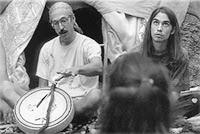 Image from White Shamans and Plastic Medicine Men, 1996
Invisible examines the history of relations between the Anglo and Native American communities in the northeast. The tribal people of Maine often feel invisible and to many Non-Indians in the state, they do not exist. Many of those who do know of the Indians presence are unaware of both their history and their present circumstances. Through the voices of persons telling their stories, Invisible looks at some of the underlying reasons for the racism so deeply embedded in white American culture and how that racism continues to shape Native American reality today. It then asks how we can begin to change our own racism and confront the invisible racism that still lies beneath much of Anglo American society.
Following these short documentaries there will be a discussion session hosted by Raney Bench, Abbe Museum Education Coordinator and James E. Francis, Penobscot Tribal Historian and Invisible producer.
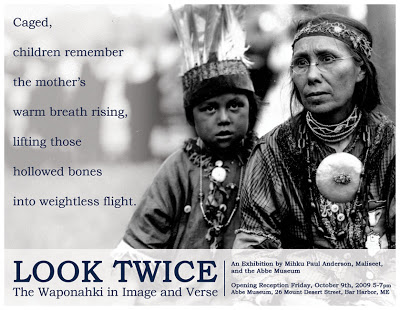
Look Twice Evokes New Thoughts About History

Friday, October 9th, 2009,
Exhibit designer and writer Anderson is a member of Kingsclear First Nation, N.B.,
the goal of redirecting the visitor's objective gaze at Waponahki life and history in this region. The river motif reflects the importance of these waterways to my people, and is symbolic of time-flow, history and memory as they function to both create and maintain identity." Mihku artfully combines her original writings, colorful graphics, and historic photography in a way that evokes new thoughts about the history of Waponahki people, the people of the Maliseet, Mik’maq, Passamaquoddy and Penobscot tribes.
This exhibit will hang in the Community Gallery of the