Abbe Museum to Make the Case for Museums on Capitol Hill

Local Museum Leaders to Join Hundreds of Citizen-Lobbyists from Across the Country Feb. 22-23
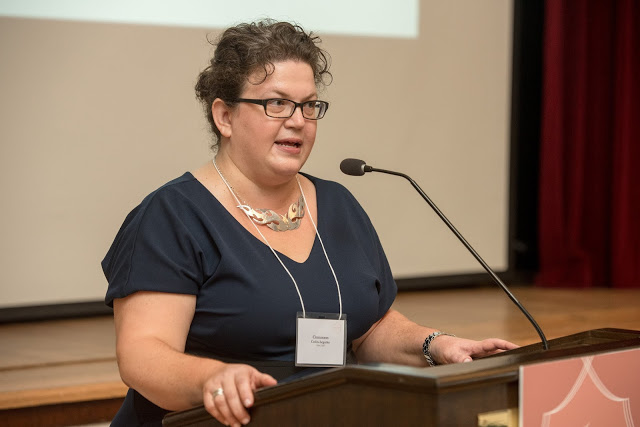
Abbe President and CEO Cinnamon Catlin-Legutko. Photo by Rogier van Bakel.

Abbe Museum President and CEO, Cinnamon Catlin-Legutko, and Director of Collections and Interpretation, Julia Gray, will travel to Washington, D.C. February 22-23 to petition our government and make the case for museums.

Joined by other museum leaders from Maine, Catlin-Legutko and Gray will be visiting members of Congress and their staff to make the case for federal support of America’s museums. They will be among more than 200 museum professionals and supporters from across the country participating in the eighth annual Museums Advocacy Day, organized by the American Alliance of Museums.

Catlin-Legutko and Gray are rising to the occasion to educate elected officials and inspire support for museums, at a critical time—just as Congress begins its work for the year.

“Legislators have a lot of issues on their plates, and we can’t expect them to fully appreciate the museum field unless we bring the message to their doorstep,” said Catlin-Legutko. “We want to make sure Congress knows about the indispensable work museums do, and their role as educational and economic assets.”

As the first and only Smithsonian Affiliate in the state of Maine, the Abbe Museum is trying to do more than just be a cultural and historical institution. Education is central to its mission, and with the launch of a new strategic plan this past fall, the Abbe’s mission hasn’t changed, but its vision has a new focus.

“Decolonization, which means sharing authority for the documentation and interpretation of Native culture, has been the Museum’s touchstone and guiding principle for many years,” said Catlin-Legutko. “As the only museum in the world dedicated to telling the story of the Wabanaki, we are committed to an ongoing process of better understanding Wabanaki culture, history, and values and examining and changing our practices to assure they reflect those values.”

Decolonization is an emerging concept in museum practice in the United States, and the Abbe is deeply committed to work that positively impacts the tribal communities and the museum industry. The Abbe is already a resource and a model that the museum field turns to for ideas, solutions, and strategies for comprehensive museum decolonization and the board and staff will deepen and broaden that commitment.
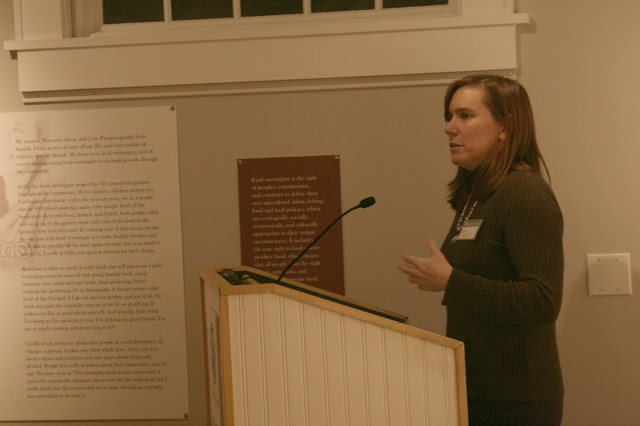
Abbe Museum Director of Collections and Interpretation Julia Gray. 

This is emblematic of the work museums of all types and sizes are doing nationally. According to the American Alliance of Museums, there are more than 850 million museum visits annually in the U.S.– more than the attendance at all major league sporting events combined. Museums invest more than $2 billion in educational programs each year, serving Americans of all ages and income levels, in a variety of ways. There are more than 55 million visits by schoolchildren to U.S. museums each year, and museums are among the most trusted sources of information for Americans.

Another study found that for every $1 invested in museums and other cultural organizations, over $5 is returned in tax revenues through cultural tourism and related economic activity.

Catlin-Legutko and Gray will be sharing these and other facts about museums with the Maine Congressional delegation.

“Museums are essential to communities everywhere, as part of our educational infrastructure, as economic engines, and as community assets that improve the overall quality of life,” said American Alliance of Museums President and CEO Laura L. Lott. “We feel privileged that Cinnamon Catlin-Legutko and Julia Gray will be joining us in Washington for Museums Advocacy Day. The Abbe Museum is doing extraordinary work in Bar Harbor and the members of Congress from Maine need to hear from constituents about how the Museum serves its community.”

For more information on the Abbe Museum, visit www.abbemuseum.org. For more information on museums and their impact on communities nationally, visit www.aam-us.org.

# # #
Read to ME Challenge

TheRead to ME Challenge is a month-long public awareness campaign beginning in February 2016 to promote childhood literacy in Maine.

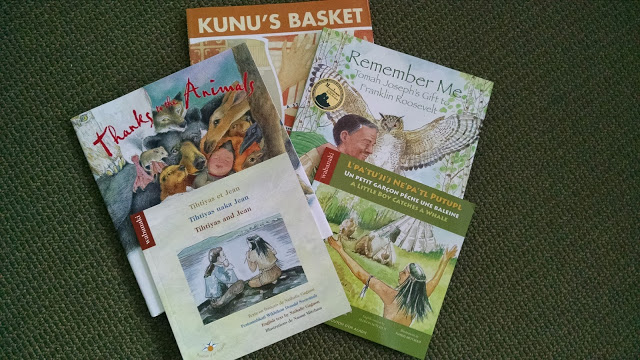
Looking for a good book for theRead to ME Challenge February 2 through March 2, 2016? There are some amazing Wabanaki authors out there you should check out! Take a journey of friendship between Passamaquoddy birchbark artist and guide Tomah Joseph and future president Franklin Delano Roosevelt in Donald Soctomah's book Remember Me: Tomah Joseph's Gift to Franklin Roosevelt. Cross the sky with Muin through the telling of a very old Mi'kmaw legend inMuin and the Seven Bird Hunter's: A Mi'kmaw Night Sky Story by Lillian Marshall, Murdena Marshall, Prune Harris, and Cheryl Bartlett. Follow Kunu as he tries to make an ash basket for the first time just like the other men on Indian Island inKunu's Basket: a Story From Indian Island by Lee DeCora Francis. From ancient oral traditions to contemporary stories, there is something for everyone!

On Saturday, February 20, 2016, the Abbe is partnering with theJesup Library from 1 - 2 pm for a specialRead to ME program. Do you have personal objects that spark a specific memory? Do you have a stuffed animal, toy, or photograph which reminds you of a time you spent with a friend? Bring that with you to the Jesup Library and join Abbe Museum Educator Jen Heindel as we share some of our own memories before we readRemember Me: Tomah Joesph's Gift to Franklin Roosevelt by Donald Soctomah and Jean Flahive. After the story, we'll make miniature faux-birchbark canoes just like the one Tomah Joseph gave to Franklin Roosevelt!

Here are a few more books by Wabanaki authors:

  • Thanks to the Animals by Sockabasin, Allen J., and Rebekah Raye
  • Muskrat Will Be Swimming by Savageau, Cheryl, and Robert Hynes
  • Weska'qelmut Apje'juanu by Fitch, Sheree, and Bernard Francis
  • A Little Boy Catches a Whale by Perron, Judith Carol, and Naomi Mitcham
  • How the Cougar Came to Be Called the Ghost Cat by Isaac, Michael James, and Dozay Christmas
  • How the Petitcodiac River Became Muddy by Maillet, Marguerite, and Raymond Martin. English Version by Allison Mitcham
  • Tihtiyas Et Jean by Gagnon, Nathalie, Naomi Mitcham, and Donald Soctomah
  • Un Petit Garçon Pêche Une Baleine by Perron, Judith Carol, and Naomi Mitcham
  • Nine Micmac Legends by Nowlan, Alden

Happy reading!

Abbe Museum Staff Rocked #MuseumSelfieDay

January 20th was ‪#‎MuseumSelfieDay‬, and the Abbe staff had way too much fun snapping photos all around the Museum. There happened to be a lot going on that day in and around our main gallery as we prepare for our new core exhibit, People of the First Light, which made our photo opps all the more interesting!

We think we won #MuseumSelfieDay, for sure. At least on Facebook. Hop on over and search for "#MuseumSelfieDay" to see for yourself.


Local Wabanaki Artist Receives National Grant

First Peoples Fund, a nonprofit that supports indigenous artists across the country, recently awarded Jason Brown, Penobscot, a jewelry artist and metalsmith from Bangor, a $5,000 business entrepreneurial grant and fellowship.    

“I’m honored that my artwork and commitment to my community have been recognized by First Peoples Fund. This grant and leadership training will help me expand my work and market, and allow me to continue to give back to my culture and community,” said Jason Brown.   

First Peoples Fund, based in Rapid City, South Dakota, focuses on community and economic development for tribal communities through support for Native artists and recently announced a roster of 27 2016 Native artist-fellows from across the country.

"We are proud to continue to grow our First Peoples Fund family of artist-entrepreneurs,” said Lori Pourier, president. “We believe that when Native artists have support and opportunities to build reliable and consistent incomes through their work, they thrive, their families thrive and whole communities thrive.”

First Peoples Fund is supported in part by The Ford Foundation, The Bush Foundation, Margaret A. Cargill Foundation, Andrew W. Mellon Foundation, Nathan Cummings Foundation, Northwest Area Foundation, HRK Foundation, The Howe Family Foundation, Surdna Foundation, U.S.D.A Rural Business Opportunity Grant, and The Johnson Scholarship Foundation.

Founded in 1995, First Peoples Fund's mission is to honor and support the Collective Spirit® of First Peoples artists and culture bearers. For further information, or to apply for support through one of their programs, please visit www.firstpeoplesfund.org or contact First Peoples Fund at P.O. Box 2977, Rapid City, SD 57709-2977.

What Does Decolonization Mean?

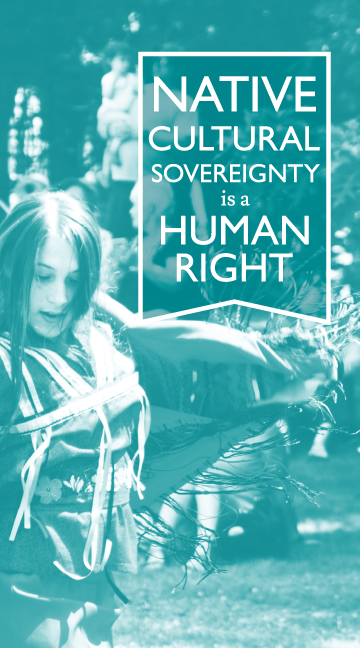
girldancingfestival_SOVEREIGNTY.png

As the only museum in the world dedicated to Wabanaki art, history, and culture, the Abbe works closely with the Wabanaki Nations, sharing authority for the documentation and interpretation of Native culture. We are committed to an ongoing process of better understanding Wabanaki culture, history, and values, and with this in mind, we have a new vision for the Abbe, one that is  groundbreaking, ambitious, and thrilling:

The Abbe Museum will reflect and realize the values of decolonization in all of its practices, working with the Wabanaki Nations to share their stories, history, and culture with a broader audience.

You might be wondering what decolonization means, orwhat it looks like in a museum setting. You’re not alone; it’s not a well-known word or practice, but it’s gaining speed and we’re proud to be a leading resource and model that the museum field turns to for ideas, solutions, and strategies for comprehensive museum decolonization.

Susan Miller, Seminole, describes decolonization as a process designed to shed and recover from the ill effects of colonization. Amy Lonetree, Ho-Chunk, states in her outstanding publication Decolonizing Museums, that “a decolonizing museum practice must involve assisting (tribal) communities in addressing the legacies of unresolved grief.”

Generally speaking, museums have historically controlled their audiences’ understanding of Native people,  sovereignty, and culture by leaving Native people and communities out of the planning and processes of museum practices. In the end, there was little to no consultation and collaboration with Native people on exhibits, archaeology, culture, history, fashion, food, music, placenames, burial remains, spirituality, education, and much, much more. This practice is certainly evolving, but the museum field has a long road to travel, righting these inequities of the past and planning for a collaborating present and future.

The principles of decolonization inform how the Abbe builds, understands, and exhibits its collections, and they affect who shapes and tells the stories in our galleries and programs. Decolonization is part of our governance and policy and practice, the training of all staff (including those who greet and educate visitors), and even determines what is sold in our Museum shops.

We’ve got big ideas for the future, and ourstrategic planincludes designing and installing a new core exhibit, producing the Abbe Museum Indian Market, expanding our dialogue-based programming, implementing a new and improved web presence, developing an archaeology advisory committee, and creating an online collections database. We plan to share updates, projects, and milestones on the website and blog each week, so be sure to visit often (and ask questions)!

This new plan and vision are the result of years of discussions, interviews, research, writing, and testing. The plan represents a critical transition in the history of the Abbe, and it’s a journey we’re excited to embark on!

Peacebuilding at the Abbe

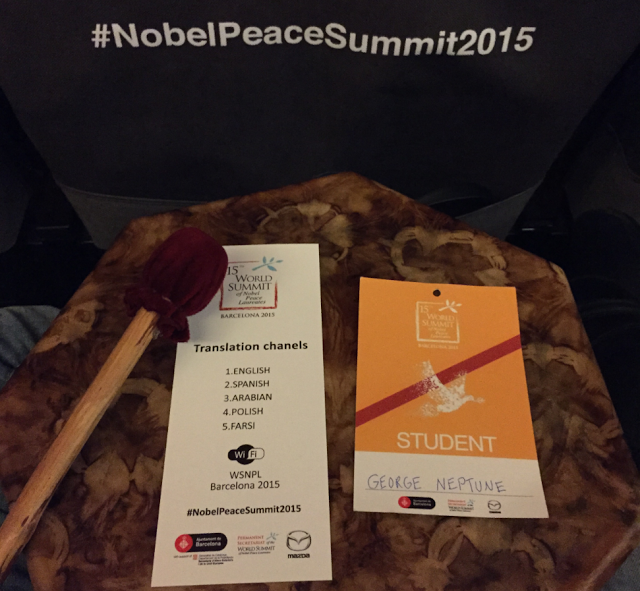
The World Summit of Nobel Peace Laureates is the largest annual event in peacemaking. Needless to say, attending an event such as this is an incredibly daunting task—especially when you’ve been chosen to be the first Native youth delegate to attend.

Why was I chosen? Could they not find someone better? What if I speak too strongly, or am not strong enough? What if I misrepresent my people? What if?

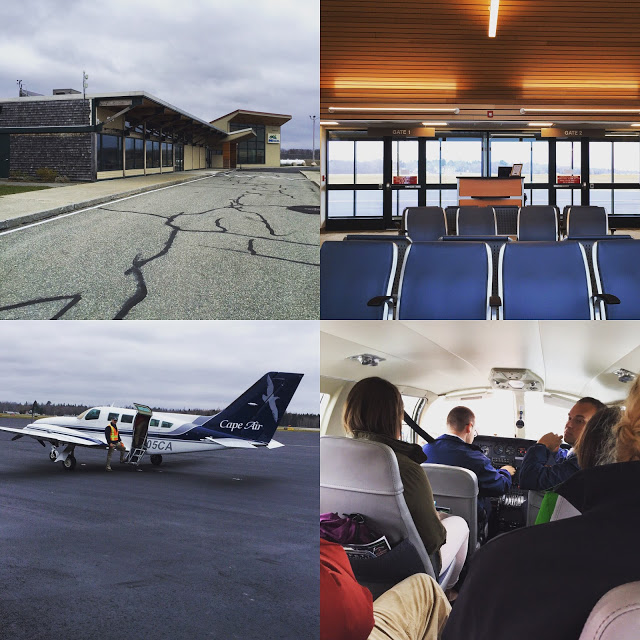
These questions raced through my mind at what seemed like a thousand times per second as I checked in at the Bar Harbor International Airport. With my hand drum and my mother’s eagle feather tucked into a compartment on the wing of the tiny plane, I embarked on a journey that already felt like one of the most significant and terrifying experiences of my life. 

I was excited to be able to hear from the Nobel Laureate’s directly—last year, due to various political reasons, the Summit was postponed and I attended the Global Youth Peace Indaba in Capetown, South Africa, instead. I knew that the Summit would be very different from the Indaba, and the chance to be able to ask questions of today’s leading peacemakers made me feel nervous and intimidated. I arrived in Barcelona, Spain, prepared to consider ways in which peacebuilding can be incorporated into my work at the Abbe Museum and armed with the goal of creating the first Native Youth Delegation to the Summit in 2016. After visiting the city in high school and spending three months there as an undergraduate, it was as if I was returning to a home away from home.

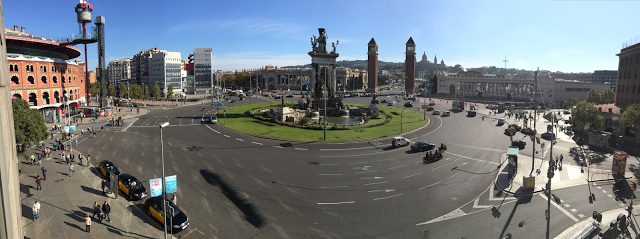
Plaza Espanya, Barcelona

After one brief evening of getting to know the other delegates, the Summit began like a whirlwind. The opening ceremony and sessions took place at the Universitat de Barcelona and began with a welcome by the mayor of the city, Ada Colau. I found that even though I hadn’t heard the Catalán language since I left the city in 2008, I understood the majority of what was said! Not only did Mayor Colau express gratitude to the Laureates and Secretariat for choosing Barcelona, but she also set the tone for the rest of the Summit by publicly stating that Barcelona would welcome Syrian refugees. This led to larger discussions regarding refugees, with other Laureates pointing out the fact that this is not a new humanitarian crisis, and that the root causes of war must be eliminated in order to create peace. Laureate Mairead Maguire, from Northern Ireland, stated that eliminating the roots of war—specifically, ending militarism—would ultimately be up to young people. She believes that the youth is more ingenious than previous generations, and she apologized to the youth delegates for the world that would one day be handed to us.

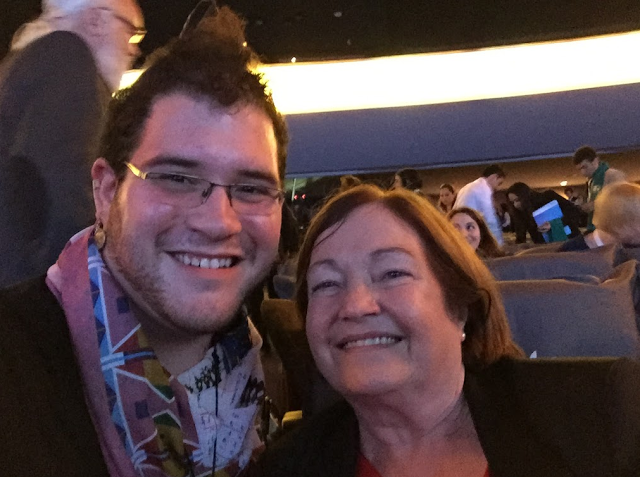
Me and Nobel Laureate Mairead Maguire.

Laureate Mohammed Yunus, from Bangladesh, echoed Maguire’s message, stating that creating a new civilization is the mission of our generation. He stated that, with 20 million refugees around the globe, the world needs direction from the peace Laureates. His message was that the concentration of wealth and the unemployment of young people worldwide ultimately makes for an unsustainable society; he encouraged that we, as human beings, are not job seekers but job creators and that unemployment is the artificial creation of wrong-thinking. If we are to achieve the United Nation’s Sustainable Development Goals by the year 2030, then we, as young people, needed to take action. These goals are meant to serve as guiding steps to achieving sustainable world peace.

Each of the youth delegations nominated two participants to contribute to the creation of the 2015 Youth Declaration of Peace, which would be composed of declarations pertaining to each of the Sustainable Development Goals. Students and young activists from around the world discussed ways in which we, as young people, can work to achieve these goals, and working with my colleagues from LUISS (Libera Università Internazionale degli Studio Sociali Guido Carli), Oxford University, and PeaceJam, the following was written to accompany goal number ten, “Reducing Inequalities:”    

Financial inequality, ongoing colonization, refusal of reconciliation, institutionalized and non-institutionalized discrimination, and the disparate distribution and development of agricultural and medical resources are just a few of the challenges concerning the reduction of inequality; the role of youth is key to the implementation of the Sustainable Development Goals through raising awareness and constantly learning; an effective preliminary solution for eliminating these social constructs is to encourage the unconditional appreciation of all human life (The Youth Declaration of Peace).

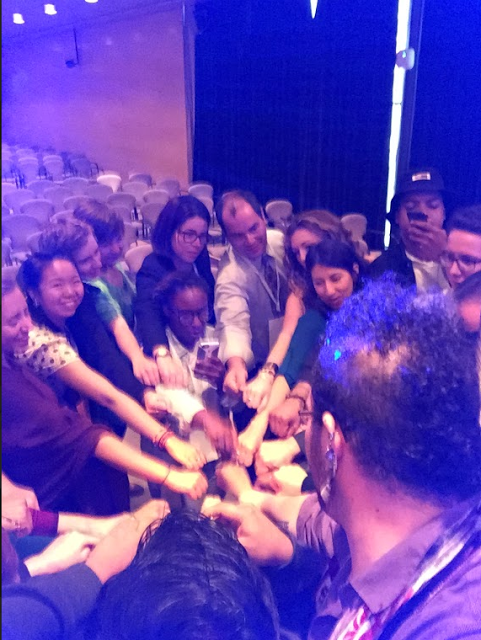
Me and other Youth Delegates after the American Friends Service Committee Workshop.

I knew that the Youth Declaration was going to be read during the closing ceremony of the Summit, but I was still surprised when my colleagues informed me that, while I was in the restroom, they had unanimously decided that I would read our section. Aloud. On a stage. In front of all the participating Laureates. The next morning, I met with the other delegates assigned to read the declaration and prepared to read in front of the world’s leaders in peacebuilding. I was, to say the least, absolutely terrified, and have never been more thankful for my theater degree. With my drum keeping my hands steady and my mother’s feather giving me strength, I walked on stage with representatives from the other delegations.

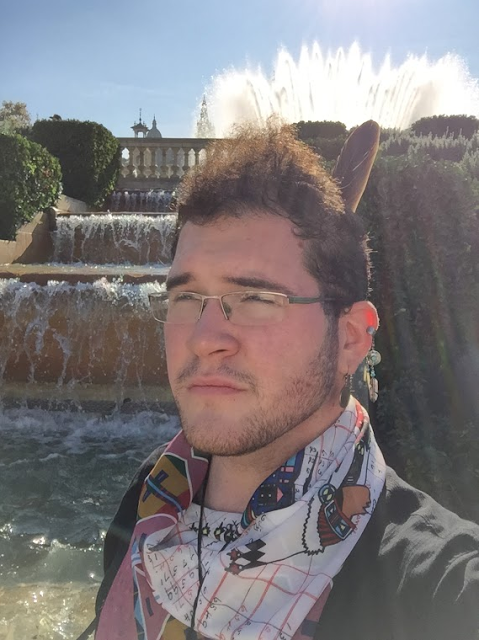
Me at Font Magica, Barcelona

My experiences in Barcelona were far too many for me to effectively summarize in one blog post. I reconnected with old friends while making amazing new ones; returned to a city that I adore; was able to ask questions of incredible peace builders including Jody Williams (a driving force in the launching of an international campaign against landmines), Tawakkol Karman (she has been called the "Iron Woman" and "Mother of the Revolution"), and Frederik Willem de Klerk (the former State President of South Africa!), and excitedly told anyone that would listen how the Abbe tackles social justice issues in a museum setting. Now, I’m conducting research to create the FIRST EVER Native Youth Delegation to the World Summit of Nobel Peace Laureates for 2016, and couldn’t be more excited to be a part of this history!

Me and Nobel Laureate Jody Williams

There were an infinite amount of meaningful messages received at the Summit. If I were to boil all of these messages down into core lessons, they would be as follows: Mohammed Yunus taught me that youth is key to making change; Mairead Maguire reaffirmed that dialogue is essential to making peace; Frederik Willem de Klerk encouraged that reconciliation is essential to decolonization, and Jody Williams stressed that empathy must be converted into action. With these lessons being added to my peacebuilding toolkit, it is my hope to share these messages with other Indigenous youth and ultimately contribute to the cultivation of sustainable peace, and create a world that my grandchildren will be proud to be a part of.

Thank you to the American Friends Service Committee, an amazing organization that made my journey possible.

Why I Give Back: Maria Biasin

After spending years working as an Abbe Guest Services Associate, Maria Biasin has said it was easy to fall in love with the staff, volunteers, visitors, and the Museum's mission, all of which keep her coming back now as a volunteer in her spare time. She loves meeting with visitors and hearing about what drew them to stop in for a visit, and what they may or may not know about the Wabanaki.

One of Maria's first volunteering tasks was monumental: cataloging the Museum's expansive library book collection.

"I wish more people knew of this enormous collection and took advantage of all the information it contained," she said.

One of Maria's most memorable moments at the Abbe actually came just a few weeks after starting as a member of the shop's staff. One day a gentlemen walked in and searched through the Wabanaki art on display, gathering up many pieces that piqued his interest.

"The other workers and I were giddy by how beneficial that was for the shop, and it made me think about how the Museum relies on big collectors like that to continue its educational outreach, and also continue formulating new and interesting exhibits."

Thank you, Maria, for your support, and for believing in what we do!

You can also become avolunteer or donateto the Abbe Museum. If you have any specific questions or comments, we'd love to hear from you! Contact us at info@abbemuseum.org or 207-288-3519.

Why I Give Back: Katherine Stroud Bucklin

Abbe Museum Trustee and volunteer Katherine Stroud Bucklin grew up in rural Pennsylvania and spent portions of her summers between Northeast Harbor, ME and Watch Hill, RI. Katherine first started volunteering at the Abbe a few years ago as anAbbe Gala Committee member, and also enjoyed helping out with theAbbe Underground events.

"The Abbe staff's naturally energetic spirit and infectious enthusiasm keeps me volunteering," she said. 

One of Katherine's favorite volunteering experiences revolves around an Abbe Underground event, and while she didn't go into much detail about why, she indicated that the events "are a lot of fun!"

Katherine graciously host events and draws upon her social networking ability to act as an Abbe ambassador, helping spread the word about Wabanaki artists, the Wabanaki people and their culture, and championing the mission and work the Museum does.

Thank you, Katherine, for your support, and for believing in what we do!

You can also become avolunteer or donateto the Abbe Museum. If you have any specific questions or comments, we'd love to hear from you! Contact us at info@abbemuseum.org or 207-288-3519.

The Maine Thing Quarterly Features the Wabanaki and Acadia National Park

The latest edition of The Maine Thing Quarterly features a chapter on the Wabanaki, which includes interviews with the Abbe's Director of Collections & Interpretation, Julia Clark, and Museum Educator, George Neptune. ‪#‎NativeAmericanHeritageMonth‬

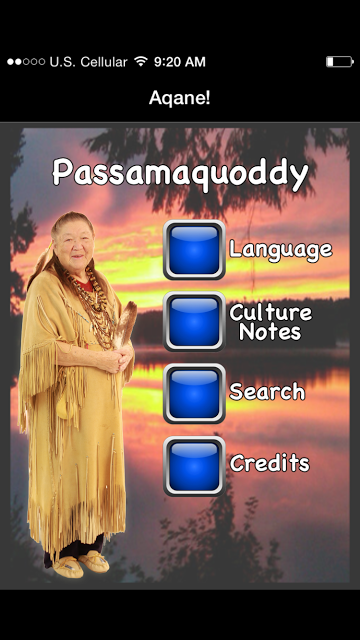
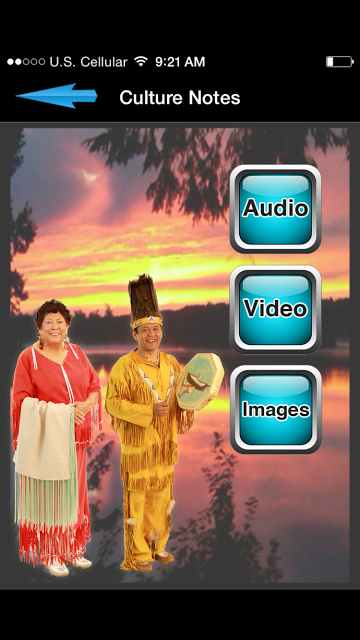
New Passamaquoddy Language App

The Passamaquoddy tribe, located at Indian Township and Pleasant Point in Washington County, Maine, has released a new app for iPhone and Android users, specifically designed to encourage the use and retention of the Passamaquoddy language—one of the few Native languages still spoken on the east coast.

Until the early 1980s, the Passamaquoddy language had been passed down entirely through oral traditions, when the tribe began developing a written system using 17 letters from the modern English alphabet. After the writing system was developed, it began to be implemented in tribal schools.

In 2008, the Passamaquoddy tribe published the first complete dictionary of the Passamaquoddy-Maliseet language, containing over 18,000 entries. At the same time, the Passamaquoddy-Maliseet Language Portal went live on the World Wide Web, providing people all over the world with access to the Passamaquoddy-Maliseet language.

The new smartphone app, available through the Apple App Store or Google Play, teaches users how to speak Passamaquoddy through written examples, audio recordings, videos, quizzes, and even games, allowing users to track their progress and improve their fluency. With categories such as office phrases, household items, commands, and traditional clothing, this app provides an easy way to practice speaking Passamaquoddy in a 21st century context.

Perhaps the most interesting aspect of this app is it's lack of availability—while anyone can download it, only members of the Passamaquoddy tribe have access to the PIN numbers required to activate the app. Cultural appropriation is a rampant problem not only in Maine, but throughout Indian Country, so the restrictions placed on the app is one way that the Passamaquoddy tribe has chosen to enforce their rights to self determination, sovereignty, and to prevent misappropriation of the Passamaquoddy-Maliseet language.

For anyone interested in learning more about the Passamaquoddy-Maliseet language, please visit www.pmportal.org. The Language Portal is free to use and open to the public, and includes audio and video links as well as pronunciation guides.

For more information on the Passamaquoddy Language App, please contact the Passamaquoddy Tribe at Indian Township or Pleasant Point , Maine.

Meet a Wabanaki Artist Fellow: Donna Brown

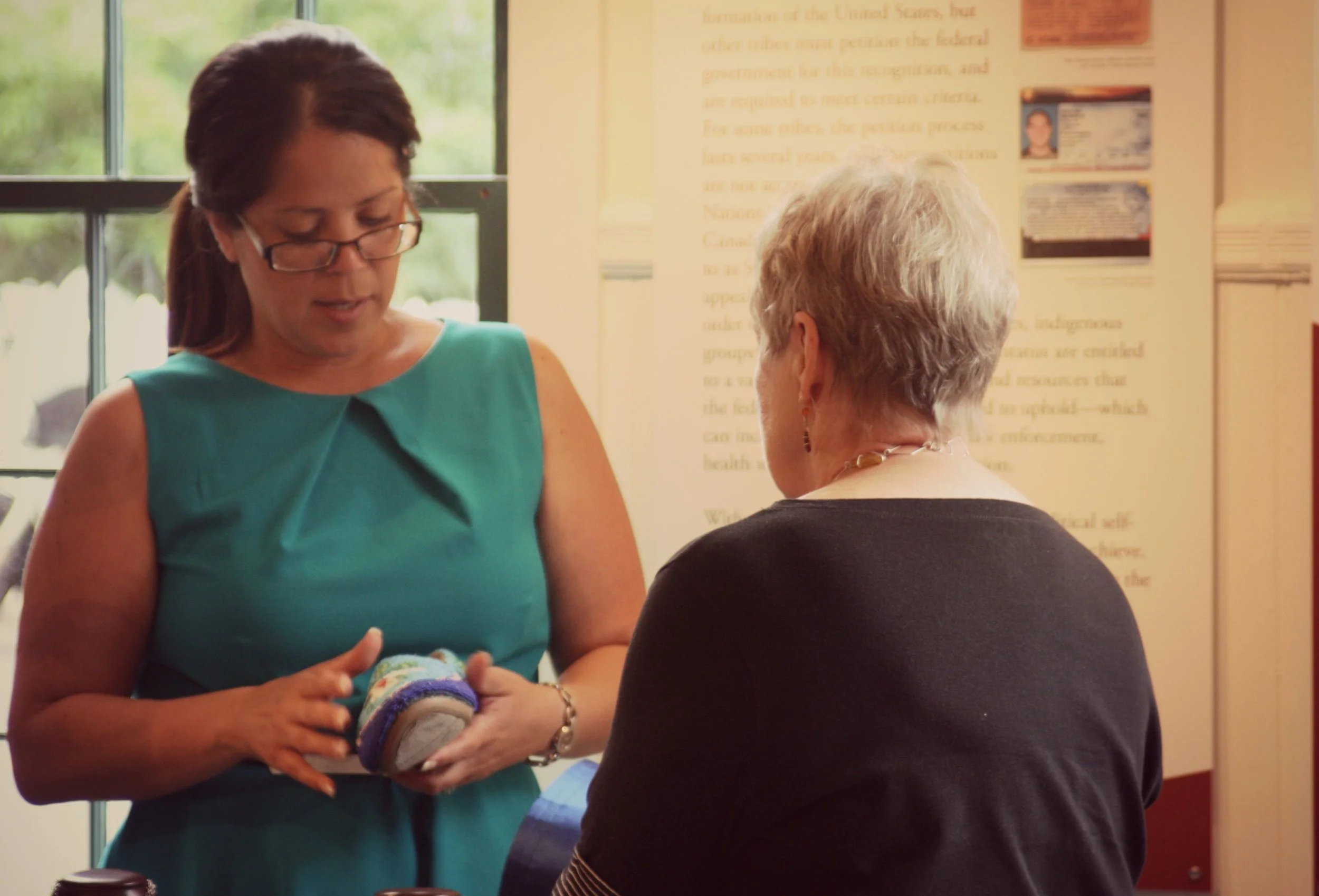
Donna Brown talked about her beaded moccasins with Abbe Trustee, Sandy Wilcox, at the Museum's annual meeting in August.

Donna Brown talked about her beaded moccasins with Abbe Trustee, Sandy Wilcox, at the Museum's annual meeting in August.

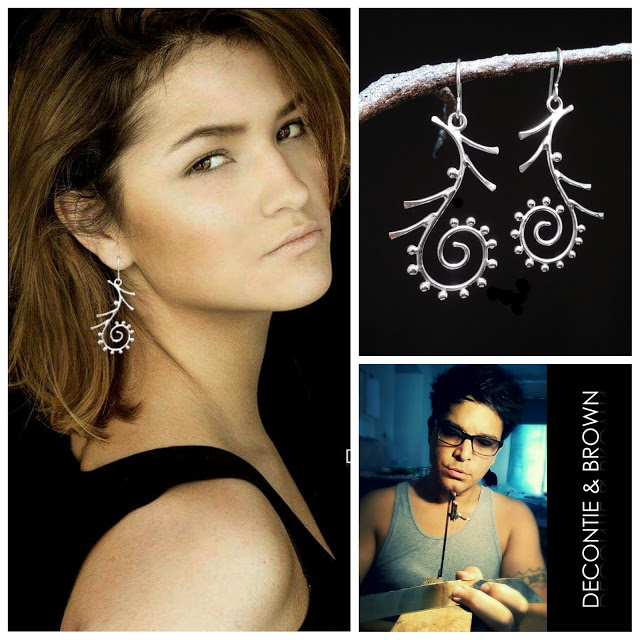
Donna Brown, Penobscot, handcrafts jewelry and traditional beadwork made from various metals, semi-precious gemstones, and glass beads. She uses stringing and metal shaping techniques to create various types of earrings, necklaces, and bracelets, and also uses intricate beadwork techniques to create jewelry and regalia accessories by beading with cloth, leather, and a loom. She has beaded on items such as moccasins, shoes, belts, barrettes, shawls, earrings, and hair ties.

"My work is motivated by my desire to create colorful jewelry and regalia that will be passed on to future generations," Donna said in her fellowship application's artist statement. "I am inspired by the colors and elements of nature, as well as my Wabanaki culture, and I am passionate about creating miniature works of art that begin with a sketch or outline of a pattern and seeing it come to life through the work of my hands. It gives me great joy to see others enjoy and wear my creations, whether for everyday wear or worn specially for traditional gatherings."

Donna is working hard to build her business and cultivate her brand to a level of success that will allow her to broaden her reach into the jewelry and fashion industry.

"I feel once I have gained access to this industry, I can share the beauty and significance of our culture through my designs and creations. It is also my goal to teach others my skills to serve as a mentor and help keep our traditions alive."

In July, Donna attended the Native American Festival as an Abbe Museum Fellow. She and her husband, Jason, are the creative force behind Decontie & Brown  and have been creating jewelry for the past 20 years.

"This fellowship will also support me by allowing me access to some of the tools and supplies that are needed to sharpen and polish my brand. By presenting my jewelry in a professional and attractive way, I add value to my creations, my brand, and to Native American jewelry and art. Wabanaki artists who attend the Maine Indian Basketmakers Alliance shows, are in the unique position of presenting their creations to collectors from around the world. My goal is to utilize this opportunity by attending these shows and presenting my creations in the same manner as top jewelry designers, utilizing cohesive display presentation and product packaging. 

The Abbe Museum Wabanaki Artist Fellowships were made possible through support from Dawnland, LLC, the concessioner in Acadia National Park.

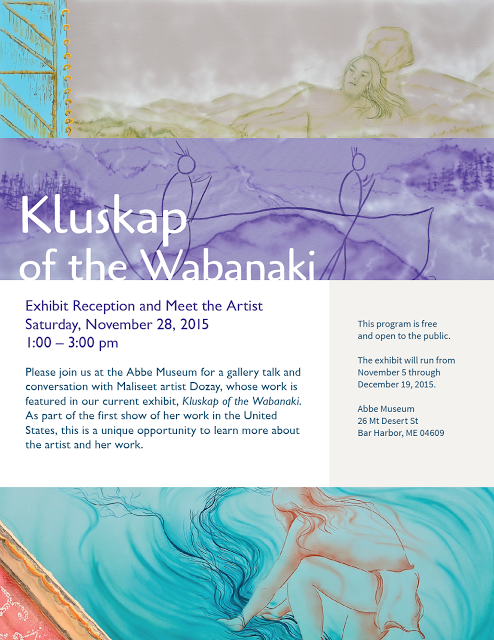
New Exhibit by Native Artist Dozay Coming to the Abbe Museum

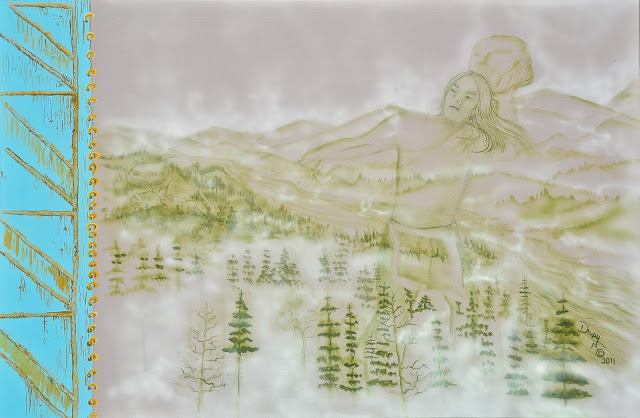
Original paintings illustrate the various legends of Kluskap and his adventures. Image courtesy Dozay.

The Abbe Museum is pleased to announce the opening of Kluskap of the Wabanaki, an exhibit by Maliseet artist Dozay. Consisting of original paintings, the exhibit illustrates the various legends of Kluskap and his adventures across the Wabanaki homeland, using landmarks that tell his story. It will be on display from November 5 through December 19, 2015, with a reception and meet the artist event on Saturday, November 28th from 1 - 3 pm at the Museum.

“I chose this subject because, in every eastern state and province, there are landmarks that the Wabanaki people have always known to be important,” said Dozay. “These landmarks tell of Kluskap and his many teachings. I learned, after showing this exhibit previously, that it was totally new to many people, even among the Wabanaki people.”

According to Wabanaki oral histories, Kluskap–or Koluskap, Gluskap, Glooskap, and Gluskabe–made the world habitable for human beings and taught people to live wisely. Kluskap stories have been told and retold over many generations, and these legends have always been known to teach lessons of values, and the characteristics of the animals and Mother Earth. Kluskap was a positive force with all Wabanaki tribes, and people from all the communities have written and illustrated many versions of the Kluskap legends.

“I have discovered that most legends are simply told and not illustrated,” Dozay stated. “I feel and have experienced that our Wabanaki tribes and cultural significance are known and considered significant among our own people, but lacking in mainstream Aboriginal teachings. Wabanaki ways were not taught in school or even recognized as a distinct Aboriginal culture, and my objective is to make our own people aware of our hero Kluskap by illustrating his adventures in combination with the importance of our Mother Earth.”

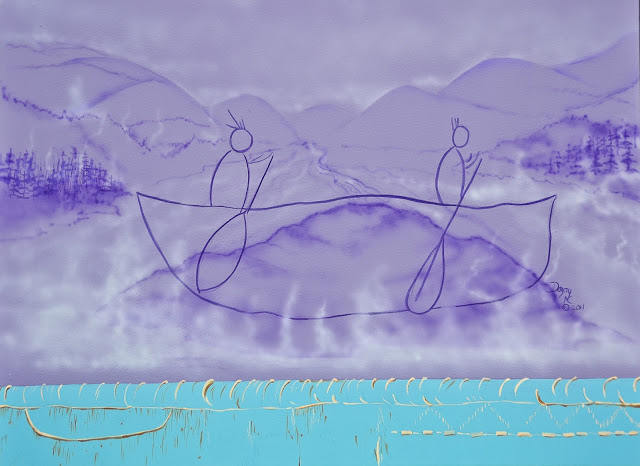
Kluskap and Grandmother in Stone Canoe. Image courtesy Dozay.

Dozay, one of a very few professional Native artists in Atlantic Canada, has spent much of her life cultivating her passion for art. Growing up in Western New Brunswick on the Tobique First Nation, she left the banks of the Tobique at 18 to pursue a formal education at Nova Scotia College of Art and Design. Although she had always displayed an interest in art, her intention had initially been to pursue a career in education. It wasn’t until her third year of college that Dozay decided to switch to the fine arts program and pursue a full-time career as an artist. This is her first first show in the U.S.

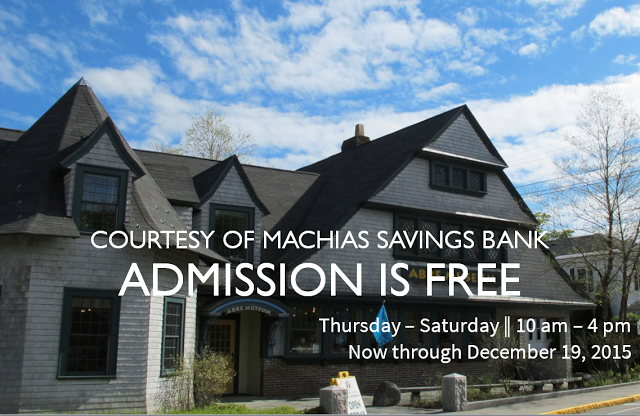
The Kluskap of the Wabanaki project is unique in that it will eventually include all Wabanaki Kluskap legends of the east. The exhibit will be on display in the Community Gallery of the Abbe Museum’s downtown Bar Harbor location until December 19. Admission is $8 per adult, $7 for senior citizens, $4 for children (11 – 17), and children 10 and under are free. Admission is free to Native Americans and Abbe members.

October at the Abbe

When I started at the Abbe back in December, I hoped life would never be dull here, and my expectations were, in fact, exceeded—I’ve found creative and remarkable people, ingenious ideas, boundless energy, exciting programming, and stimulating exhibits. I am exactly where I’m meant to be—back home in Maine and working at an organization that not only inspires me every day, but one I believe in wholeheartedly. We're doing all this amazing, important work and I get to play a part in all of it!

And now it's October. One of the things that I haven't quite been able to grasp this year is the passage of time. 2015 has been going at such a fast clip, and the fact that it's October (my favorite month!) is slightly hard to believe. If you're feeling the same way I am, don’t despair—we have plenty to offer at the Abbe this month, including exhibitions, festivals, programming, and activities that will keep you entertained and engaged, whether you’re on a family outing or taking some “you” time to reflect and get inspired.

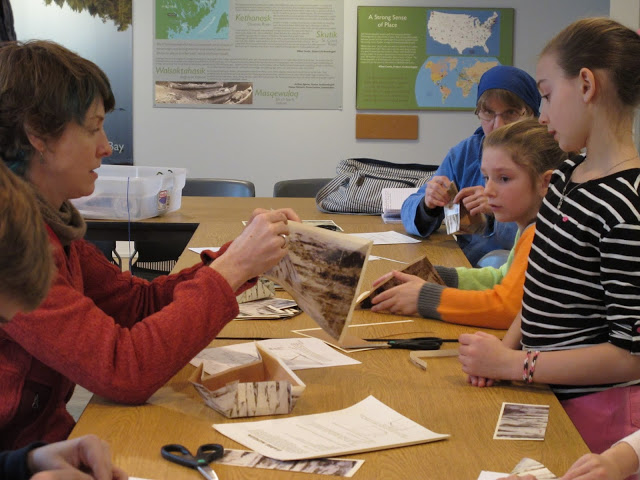
We're partnering with theMount Desert Island YMCA this year on a couple of programs, the first of which is Thursday, October 8th. The Children's Wabanaki Map Workshop, from 3:30 - 4:30 pm at the YMCA, will explore how Wabanaki people made story-like birchbark maps, orwikhikonik, using specific symbols that were used as forms of communication between two separated parties. You’ll be able to use a piece of imitation birchbark to tell a story of your choosing and create your own  wikhikonik ! This workshop is free and open to the public.

For those of you traveling to Bar Harbor this weekend (October 10th), there's a LOT going on at the Museum. We have two festivals occurring— Bar Harbor Film Festival andBar Harbor Children's Book Festival —and afree Teacher's Workshop. Because of the all the activity, we'll be shuffling around some exhibits, which means not all the exhibits will be open this weekend. If you are hoping to see theWaponahki Student Art Show (which closes the end of this month),  The Greatest Mountain, orLayers of Time, you might want to aim to come by on Monday, October 12th, when all three will be re-opened. And what better way to re-think Columbus Day than by coming to a Native American museum to celebrate Indigenous Peoples' Day!

We're also doing something this weekend that we haven't done in quite a while: admission will be by donation on Saturday the 10th and Sunday the 11th. Regular admission rates are $8 for adults and $4 for children ages 11 - 17; children 10 and under are free, as are Abbe members and Native Americans.

The inaugural Bar Harbor Film Festival kicks off at the Abbe on Friday evening, October 9th, at 6 pm and admission to the opening reception is free if youRSVP online. Check out theBHFF website for a full schedule of the weekend's film screenings and programs, and you can also purchase tickets for all of the Festival's events (there's different pricing depending on what you'd like to do). Or, stop by the Abbe Museum Shop and pick up your tickets in person.

Abbe Museum members get in free!
The Bar Harbor Children's Book Festival is free and open to the public, so please stop by between 11 am and 3 pm for some author and illustrator workshops.

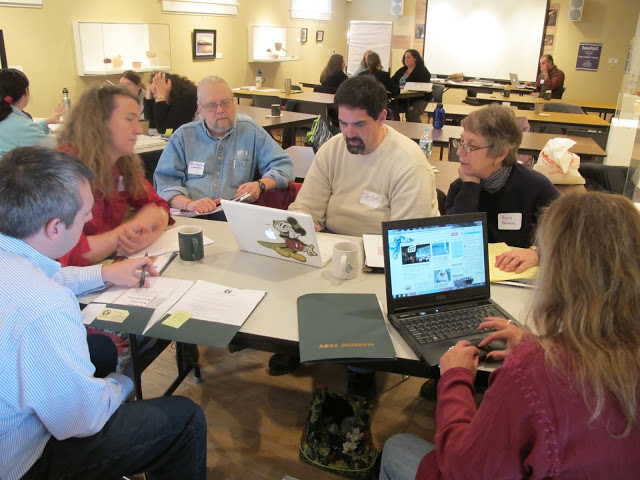
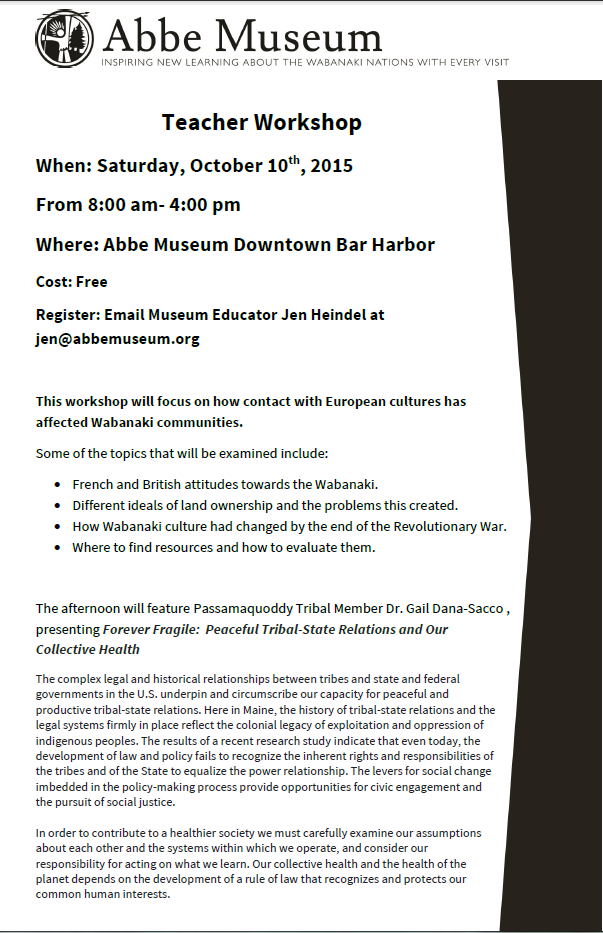
Our free Teacher's Workshop on Saturday, October 10th from 8 am to 4 pm will focus on how contact with European cultures affects Wabanaki communities. Some of the topics that will be examined include French and British attitudes towards the Wabanaki, different ideals of land ownership and the problems this created, how Wabanaki culture had changed by the end of the

Revolutionary War, and where to find resources and how to evaluate them. Teachers will earn eight (8) Contact Hours for the workshop. To register, please contact Museum Educator Jen Heindel at jen@abbemuseum.org or call 207-288-3519.

On Thursday, October 15th, our annual film series is back, and this year’s theme focuses on the ideas ofContinuity, Change, and Resistance . The first film, Weaving Worlds, is a documentary about Diné (Navajo) rug weaving, and viewers will see one of the many perspectives on how Indigenous peoples in America have ensured economic and cultural survival through contemporary art. After the movie, join Museum Educators George Neptune and Jennifer Heindel for a discussion about the survival of traditions in the face of globalization. The film series is free and open to the public, and sponsored by Reel Pizza.

One of our most anticipated fall programs, Tea & Popovers Archaeology, will take place at the Jordan Pond House on Monday, October 19th from 7 - 9 pm. Our guest speaker this year is Chris Sockalexis, Penobscot Nation Tribal Historic Preservation Officer, and he'll present on the topic of petroglyph sites in Maine. This is a very popular evening and we've already filled a lot of seats! RSVP to 207-288-3519 or info@abbemuseum.org. The cost is $20 for Abbe members and $30 for non-members.

Click here for full event listings for October.

Addition to the Abbe Museum Collections

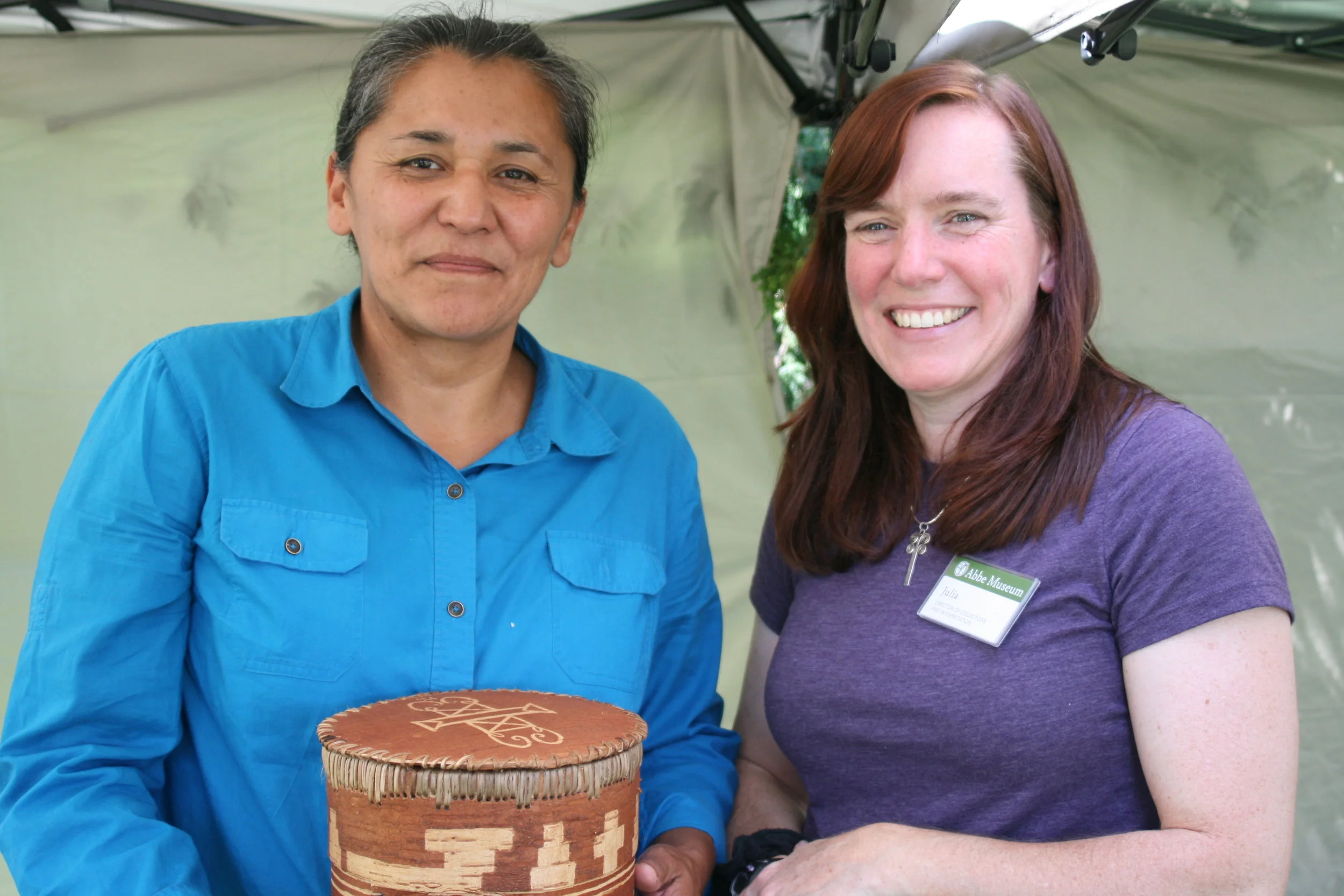
Maliseet artist Gina Brooks and the Abbe's Director of Collections & Interpretation, Julia Clark

Maliseet artist Gina Brooks and the Abbe's Director of Collections & Interpretation, Julia Clark

TheDiane Kopec Collection Fund at the Abbe Museum was created to acquire works by living Native American artists. The collection reflects the vitality and vibrancy of Native American art today, and we recently added a birchbark box by Maliseet artist Gina Brooks to this important collection.

The imagery on the box includes the wampum pattern representing the Wabanaki Confederacy, the people holding up that confederacy, and on the lid, the double curve that represents the unity of the four tribes. Native people sent and received Wampum woven into belts as a form of communication. Through the geometric patterns of the beads, Native people wove wampum designs to remember and recall important events like oral histories, treaties, and agreements. These belts were brought back and forth from important events, and passed down from generation to generation.

Gina Brooks, Maliseet, is from St. Mary’s First Nation in New Brunswick, Canada, and resides in nearby Fredericton. She considers herself an artist informed by Wabanaki traditional knowledge, and her art includes brown ash basketry, porcupine quill and birch bark basketry, carving, and print making. Her original prints include acrylic and ink, and lithographs, monotypes, and copper etch plating. Her basketry and print art has been commissioned by private art collectors and Aboriginal organizations across Canada, and her work has been exhibited at the Charlotte Street Arts Center in Fredericton, Sudbury Nature Center in St. Andrews, (Weaving Traditions), and is featured in the New Brunswick Museum’s Wabanaki contemporary art collection.

Abbe Museum Welcomes New Trustees

The Abbe Museum has added four new Trustees to its Board of Directors, bringing the total number of Trustees to 19. The new appointees – Abbe Levin, Margo Lukens, Patti Selig, and Chris Sockalexis – assumed their new roles on August 12, 2015.

“We are excited to welcome our incoming class,” said Abbe Museum President/CEO, Cinnamon Catlin-Legutko. “Our new members bring talents and new perspectives that will complement and strengthen our already impressive Board. We have spent time building a Board that is reflective of our community, our organizational needs, and our mission, and that care and commitment has certainly paid off. It is a pleasure to work alongside the Abbe Trustees as we strengthen the Abbe Museum’s presence locally and statewide.”

Abbe Levin is a cultural development consultant, and has served as the Cultural Tourism Coordinator for the Maine Office of Tourism since 2007. In addition, Levin works with a wide range of organizations and projects to assist with the preservation and promotion of cultural resources. She currently serves on the Maine Development Foundation’s Maine Downtown Center Advisory Council and the Sheepscot Valley Children’s House Board of Directors. Levin lives in Boothbay with her husband, and has two sons.

Margo Lukens is a professor in the University of Maine Department of English, and presently serves as chair of the Department of New Media and director of academic programs in Innovation Engineering. Her research interests include Wabanaki literary and storytelling history, Native American and First Nations plays and playwrights, innovation, and making whiteness visible to white people. Her work has included producing and directing Native American plays on campus and in the region, and generally participating in as much theater as possible.

Patti Selig’s first exposure to the Abbe was in the 1980s as she and her family discovered the Museum while visiting Sieur de Monts. She and her family lived in Ocean City, Maryland for 40 years where her husband owned a large construction company and she worked as a psychologist. She spent 20 years as a faculty member and department chair with the University of Maryland system, and when she retired from her career in higher education in 2005, she and her husband purchased the Cranberry Hill Inn in Southwest Harbor. She has been active as a volunteer for the Abbe for many years, serving on the Gala Committee, the Culinary Arts committee, and working at the front desk as a greeter.

Chris Sockalexis, Penobscot, is the Tribal Historic Preservation Officer for the Penobscot Nation, and has served on the Abbe Museum Native Advisory Council since 2012. He has a BA in Anthropology from the University of Maine with his primary focus being on Maine Archaeology. He is currently conducting research for his Masters of Science degree at the University of Maine Climate Change Institute. Sockalexis is also a flintkapper with knowledge of the ancient art and technique of stone and bone tool production. Sockalexis is also an avid canoe/kayak paddler who loves being out in the Maine woods and on the waterways that his ancestors have traveled for thousands of years. He lives with his wife Jill and her daughter Taylor in Winterport, and is the proud father of Shannon, Willow, and Em.

The Abbe Museum Trustees also include: Ann Cox Halkett (Chair), Richard Cleary (Vice Chair), Katherine Stroud Bucklin (Secretary), Jeff Dalrymple (Treasurer), David Moses Bridges, Joseph F. Cistone, Linda K. Dunn, William Haviland, Jamie Bissonette Lewey, Barbara E. McLeod, Jennifer Neptune, Douglas Sharpe, Curtis Simard, Steve Wessler, Sandra K. Wilcox, and Honorary Trustees Alice Wellman and Darren J. Ranco.

September is #changemakers month at the Abbe

Please come be #changemakers with us! 

As we close out our fiscal year at the end of September, the race is on to hit our annual fund goal of $100,000. The Abbe's September #changemakers campaign is about passionate, ambitious, and proud friends helping us inspire new learning about the Wabanaki Nations with every visit, and that also includes the Abbe Museum staff!

Our staff is stepping up to be loud, creative #changemakers. With your help we've moved the needle closer to our goal, and with gifts of $100, $500, or $1,000 we'll surely hit our mark by the end of the month. If we reach our goal, the Abbe staff is prepared to do some really creative things. Head on over to the Abbe websiteto find out what everyone is prepared to do!